




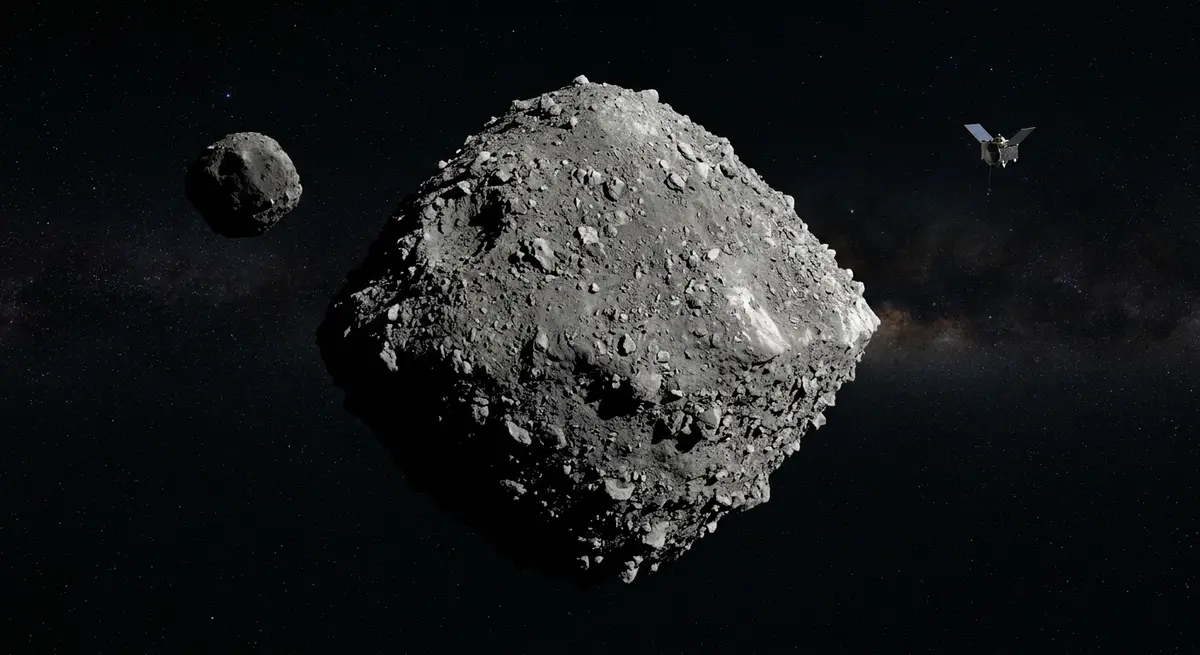
The European Space Agency’s Hera spacecraft has arrived at the pair of asteroids that NASA deliberately struck in 2022, beginning a detailed investigation that scientists hope will turn asteroid deflection into a reliable way of protecting Earth.
The car-sized probe reached the Didymos system on 4 November, more than two years after launch, and is now flying between 25km and 30km from the asteroids as it gathers its first overview of them, according to ESA.
Returning to the scene
Didymos is an asteroid about 780 metres across, orbited by a much smaller moonlet called Dimorphos, roughly 151 metres wide. Neither poses any threat to Earth. On 26 September 2022, NASA’s DART spacecraft hit Dimorphos at about 6.1km per second, throwing out a plume of debris and shortening the moonlet’s orbit around Didymos by around 33 minutes.
That proved a spacecraft could nudge an asteroid, but left key questions unanswered: did the impact leave a crater or reshape the whole body, what is Dimorphos made of, and why did it move more than computer simulations predicted?
“Hera wants to be the detective, like Inspector Columbo, going back to the crash scene,” the mission’s principal investigator, Patrick Michel, told Space.com, as reported by Smithsonian Magazine.
Flying in rectangles
The asteroids’ gravity is so weak that a normal circular orbit is impractical. ESA says Didymos has gravity about 40,000 times weaker than Earth’s, and Dimorphos about 200,000 times weaker. Instead, Hera moves in near-straight lines at around 12cm per second, roughly the pace of a crawling insect, and fires its thrusters every few days to turn 90 degrees. The result is a series of rectangular loops around the pair.
ESA says this approach, based on its experience with the Rosetta comet mission, is safe because a failed thruster firing would leave the spacecraft drifting away rather than towards the asteroids.
Early pictures already show a varied surface on Didymos, with large boulders, smoother regions and a surprisingly sharp ridge around its equator. The latest images, released on 17 November, show the asteroid from 28.5km away in visible light, in 25 colour bands and in thermal infrared from a Japanese-supplied camera, which reveals Dimorphos even when it is in shadow.
Dr Michel said Didymos spins once every 2.2 hours, and that this rapid rotation “might actually be encouraging this migration of material towards the equator, helping form this ridge”, according to ESA.
What it means for UK readers
The UK is a member of ESA and British scientists and engineers are involved in its planetary defence work. The practical aim of Hera is to learn enough about how asteroids respond to an impact that, if a dangerous object were ever found on a collision course with Earth, agencies would know how hard and where to hit it. Small asteroids of the size of Dimorphos are thought to be capable of devastating a region if they struck.
Jessica Sunshine, a University of Maryland planetary scientist who worked on DART, told Science News that planetary defence and science “are sort of two sides of the same coin”.
What happens next
ESA says detailed images of both asteroids, including the first close views of Dimorphos since the impact, will be released on 25 November. Next month Hera is due to move closer, to around 20km, for a more detailed survey. It will later release two shoebox-sized CubeSats, one of which, Juventas, is designed to attempt a landing on Dimorphos to study its surface and gravity.

