




An international team including astronomers from the University of Manchester has measured how neutral hydrogen gas clumps together across huge stretches of the distant Universe, a result scientists say could open the way to three-dimensional maps of how cosmic structure has grown over billions of years.
The work, by the MeerKAT Large Area Synoptic Survey (MeerKLASS) collaboration, used South Africa’s MeerKAT radio telescope and is published in the journal Monthly Notices of the Royal Astronomical Society.
Listening for a whisper at a rock concert
Hydrogen is the most common element in the Universe and gives off faint radio waves at a wavelength of 21cm. Rather than trying to pick out individual galaxies, the team used a technique called 21cm intensity mapping, which measures the combined glow of hydrogen from many galaxies across wide patches of sky.
According to the University of Manchester, the researchers analysed around 250 square degrees of sky, an area equivalent to roughly 1,250 full moons. The signal they detected left its source about 4.5 billion years ago, when the Universe was a little over nine billion years old.
The challenge was separating that signal from radio emission from other sources, which can be around 10,000 times brighter. Dr Laura Wolz, deputy principal investigator of MeerKLASS and a Reader at the Jodrell Bank Centre for Astrophysics, compared it to “trying to make out a whispered conversation from the front row of a roaring rock concert”.
“This is a major milestone after a decade of preparation and hard work,” she said. “By measuring the combined signal from hydrogen across huge areas of the sky, we can trace the cosmic web and build a picture of how the Universe’s structure has evolved over time.”
A new way of using the telescope
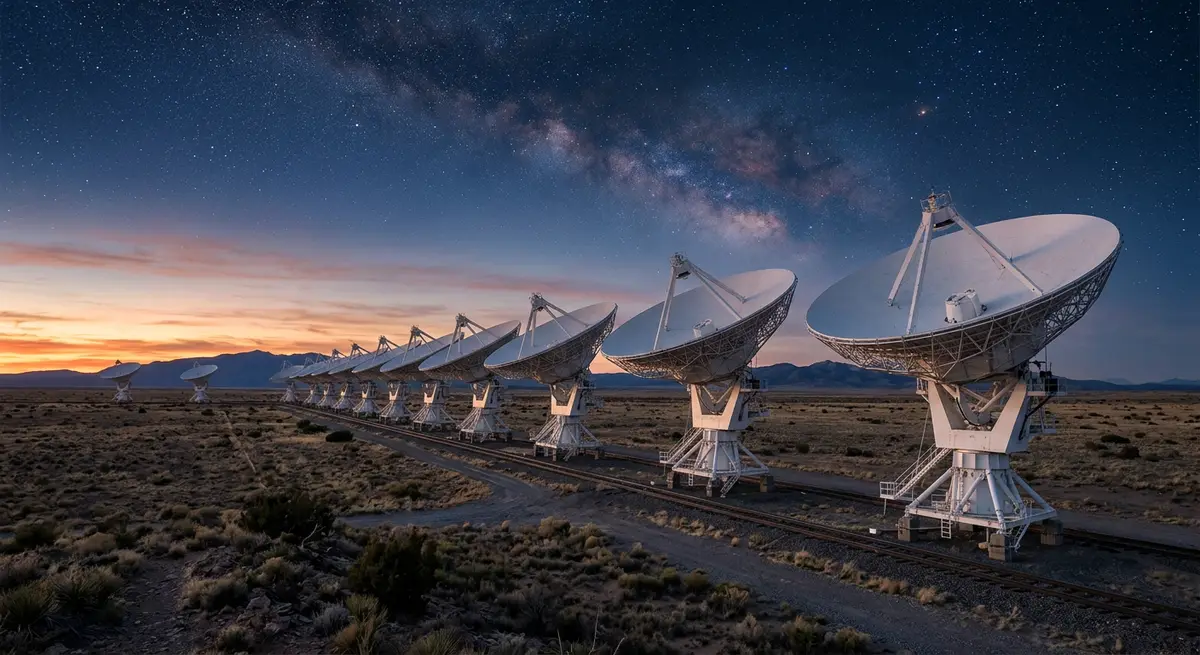
MeerKAT has 64 dishes that are normally combined to act as a single instrument. For this survey, each dish was run as an independent telescope, giving up fine detail in exchange for the ability to sweep large areas of sky quickly.
That produced many separate maps from different dishes and observing sessions. Genuine cosmic structure shows up repeatedly across the maps, while quirks from the instruments do not, allowing the team to confirm a signal more than six times stronger than the statistical noise.
The INAF Astronomical Observatory of Trieste, another member of the collaboration, said statistical techniques developed by its researchers to strip out interference and the bright emission of our own galaxy were a key part of the analysis. Its researcher Isabella Paola Carucci said the team had detected the signal “using our own data alone, without relying on other surveys”.
Professor Mário Santos of the University of the Western Cape, the survey’s principal investigator, said the measurement “took a decade of patient work by researchers spread across seven countries and three continents”.
What it means for Manchester readers
The result keeps Greater Manchester close to the centre of one of the biggest projects in astronomy. MeerKAT is a precursor to the Square Kilometre Array Observatory, whose global headquarters sits at Jodrell Bank in Cheshire, a short drive from the city. Techniques proven on MeerKAT are expected to be scaled up for the SKA, and Manchester scientists have helped lead the hydrogen mapping effort from the start.
For the wider public, the work is part of an effort to answer basic questions about what the Universe is made of and how it is expanding, including the nature of dark energy.
What happens next
Since 2023 the collaboration has been gathering data at lower radio frequencies, which corresponds to hydrogen from even earlier in cosmic history. The team eventually expects to map a volume of the Universe more than 1,000 times larger than the one used for this detection, which it hopes will help test models of gravity and dark energy.

