




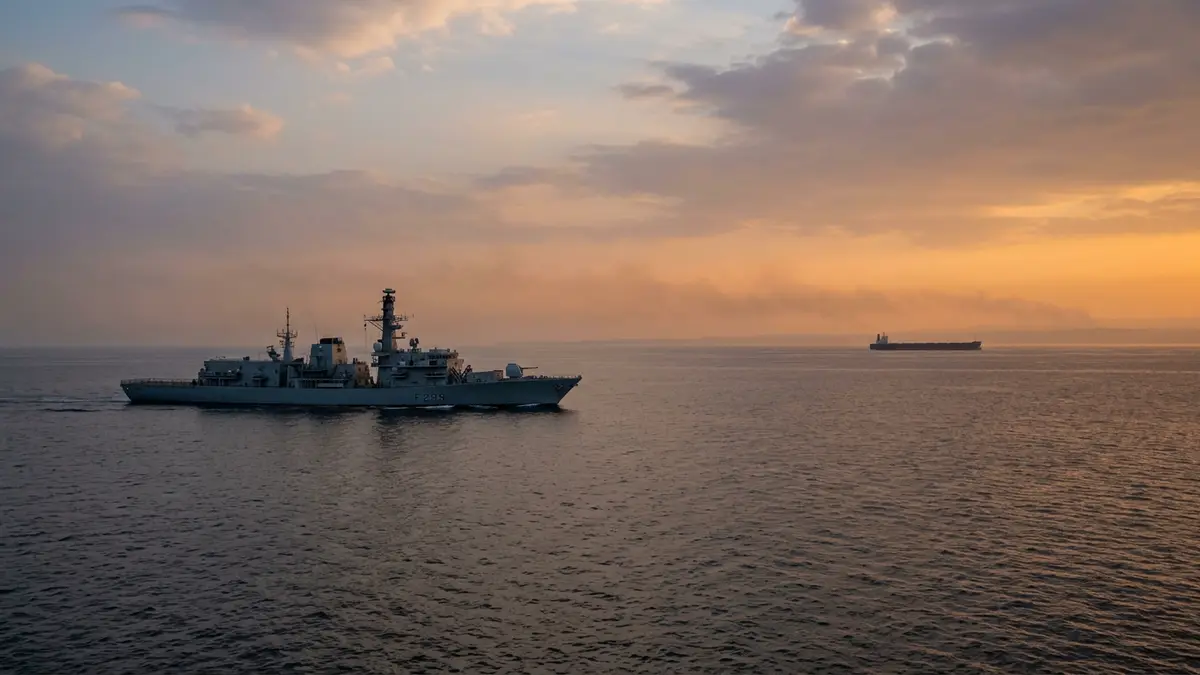
The US Iran blockade tightened again this week after American forces disabled a merchant ship in the Gulf of Oman, the sixth vessel stopped since Washington resumed its naval cordon on Iranian ports in July. US Central Command (CENTCOM) said on 27 November 2026 that a military aircraft fired “precision munitions” into the stern of the Palau-flagged bulk carrier Pacific Archer on 26 November, knocking out its propulsion. The civilian crew was unharmed.
The incident came as Iran vowed to break the blockade, the Revolutionary Guards claimed more tankers had struck naval mines, and traders watched Strait of Hormuz traffic with oil prices still elevated. Here is what is confirmed, what is disputed and why it matters well beyond the Gulf, including for British drivers and households.
What CENTCOM says happened to the Pacific Archer
According to a statement published by CENTCOM on 27 November 2026, the Pacific Archer left the Iranian port of Bandar Abbas and tried to run the blockade “despite multiple warnings”. A US military aircraft then struck the ship’s stern. CENTCOM said the vessel’s propulsion was “ultimately disabled” and that nobody on board was hurt.
The command added that US forces have now redirected 158 compliant commercial vessels and disabled six that refused to comply, and it urged all mariners in the Gulf of Oman and the approaches to the Strait of Hormuz to heed its warnings. Al Jazeera, citing the Associated Press, reported that it is at least the 15th vessel the US military has publicly acknowledged disabling since the blockade began in April, and the sixth since it resumed in July. The previous ship was disabled on 7 November.
The disputed detail: where had the ship been?
Not every account matches the US version. Seatrade Maritime, a respected shipping trade title, published analysis of satellite tracking data from Pole Star Global on 28 November 2026 that it said “shows a different picture”. According to that data, the bulk carrier sailed from an anchorage near Al Fujayrah in the United Arab Emirates on 23 November and reached the approximate blockade line in the early hours (UTC) of 25 November. It then turned towards Iran, turned back towards the UAE about nine hours later, and was disabled a day afterwards around 30 km from Khor Fakkan.
Seatrade also reported that the ship’s earlier tracking history showed no call at Bandar Abbas or any Iranian port. Its previous stops before leaving the Gulf on 19 November were Al Jubayl in Saudi Arabia and Umm Qasr in Iraq, and the vessel is not subject to any international sanctions programme. Al Jazeera noted that ship-tracking sites listed its destination as Singapore.
These accounts cannot yet be reconciled from public information. CENTCOM has consistently said US forces issue several warnings before firing on a merchant ship, and nothing published so far independently confirms the sequence on either side. That gap is worth watching, because a disabled ship that turns out not to have come from an Iranian port would raise legal and diplomatic questions for Washington, especially with the crew’s flag state and owners involved.
Iran’s response: mines, threats and a “break the blockade” vow
Tehran’s reaction was swift. The commander of the Iranian navy, Shahram Irani, said on state television on 27 November that Iran would carry out operations “that will not only break the naval blockade but also drive the enemy out of the region’s waters”, as reported by Al Jazeera. Reuters reported the same day that Mohammad Mokhber, an adviser to Iran’s Supreme Leader Ayatollah Mojtaba Khamenei, said Tehran would keep the Strait of Hormuz shut and would break the US embargo.
The Islamic Revolutionary Guard Corps (IRGC) also said two tankers tried to cross the strait by an “unauthorised” route, one of them striking a naval mine north of Ghavam (Ghanem) Island while the other was turned back. Later reports citing Iranian sources said two tankers caught fire after hitting mines, one near Oman’s Khasab port. These claims could not be independently verified, and CENTCOM has denied other Iranian assertions, including that the IRGC retook two seized tankers or struck the aircraft carrier USS Abraham Lincoln.
Italy added a further strand to the crisis. Foreign Minister Antonio Tajani told the Italian Senate that two Italian technicians working for Rheinmetall Italia were killed on 26 November 2026 when drones struck an air-defence detection station in Kuwait, and he said the drones were of Iranian origin. Kuwait’s Defence Ministry also blamed Iran. Tehran denies launching them and has offered to join a joint investigation.
A blockade with a long history this year
The confrontation is the product of a war that began in February 2026, when the United States and Israel struck Iran and Tehran responded by imposing its own restrictions on the Strait of Hormuz, the narrow waterway through which a large share of the world’s seaborne oil passes. Washington’s blockade of Iranian ports began in April, was lifted temporarily during talks and resumed in the middle of July after those talks collapsed, according to The Hill and Deutsche Welle.
Since then the US has kept a large naval force in the region, including two aircraft carriers, Al Jazeera reported. Earlier this month Washington also announced a separate effort, Task Force Iron Gate, to restrict the movement of weapons and sanctioned materials across Iran’s land borders and the Caspian Sea, Reuters said.
The Irish broadcaster RTE reported on 28 November that Iran has said the Strait of Hormuz could reopen within two days, but only if Washington agrees to a list of Iranian demands that includes lifting the blockade. There is no sign of the US accepting that, and the two sides remain far apart.
Why oil markets are watching
For readers in Greater Manchester and across the UK, the link is energy. Oil and gas are priced globally, so a contested Hormuz feeds into the cost of petrol, diesel, heating oil and, indirectly, the wholesale gas that sets household bills. The Daily News Egypt reported, citing ship-tracking data, that traffic through the strait is running near its lowest level in a month, which has kept prices high.
Prices have nonetheless been less volatile than the headlines suggest. Analysis published by House of Saud noted that Brent crude settled at $92.57 a barrel on Friday 20 November 2026, its third consecutive weekly loss, arguing that markets have largely assumed the strait stays contested but never fully closes. That assumption is being tested by each new mine claim and each disabled ship.
OPEC meets on Sunday
The next scheduled market event is a meeting of OPEC on Sunday 29 November 2026 to set 2027 production targets, according to the World Watch news digest. Producers inside the Gulf face the sharpest dilemma: they can pump more to offset lost supply, but only if the crude can physically leave through the strait or via alternative export routes. Any signal from the meeting on volumes will be read closely by traders on Monday morning.
What it means for UK readers
Britain is not a party to the blockade, but it is not insulated from it. A sustained rise in crude prices usually reaches forecourt pumps within weeks. The Financial Times also reported on 28 November, citing people familiar with the matter, that US forces repelled around half a dozen drones swarming RAF Lakenheath earlier this month, with Iran suspected of involvement. Reuters carried the report; neither government had confirmed details at the time of writing.
Shipping and insurance costs are the quieter channel. Hormuz-bound vessels are already paying more for war-risk cover, and Seatrade Maritime has reported a rush for GPS-resilience technology on ships trading in the area because of signal interference. Those costs eventually show up in what goods cost on British shelves.
The picture elsewhere in the world is also crowded. EU leaders ended their Brussels summit without agreement on the next seven-year budget, a story we covered in EU budget deal fails: leaders push Ukraine loan to December, and Russia and Ukraine traded another heavy night of drone strikes on 28 November. But the Gulf remains the story with the most direct effect on British bills.
What to watch next
- Verification of the Pacific Archer’s route. Further tracking data or an official US response could settle the dispute over where the ship had been.
- Iranian retaliation. Tehran’s pledge to “break” the blockade raises the risk of more incidents involving tankers, mines or drones.
- The OPEC meeting on 29 November 2026. Output targets for 2027 will shape the price outlook.
- Diplomacy. Iran’s conditional offer to reopen Hormuz within two days shows channels remain open, even if the demands are far from Washington’s position.
For now, the facts are limited to what each side says and what independent tracking can show. The US maintains that it enforced a lawful blockade with warnings. Shipping analysts have raised questions about the ship’s movements. Iran has promised a response. What happens in the Gulf of Oman in the next few days will determine whether this remains another incident in a long standoff or becomes a sharper escalation.
Sources include US Central Command and Al Jazeera.


