




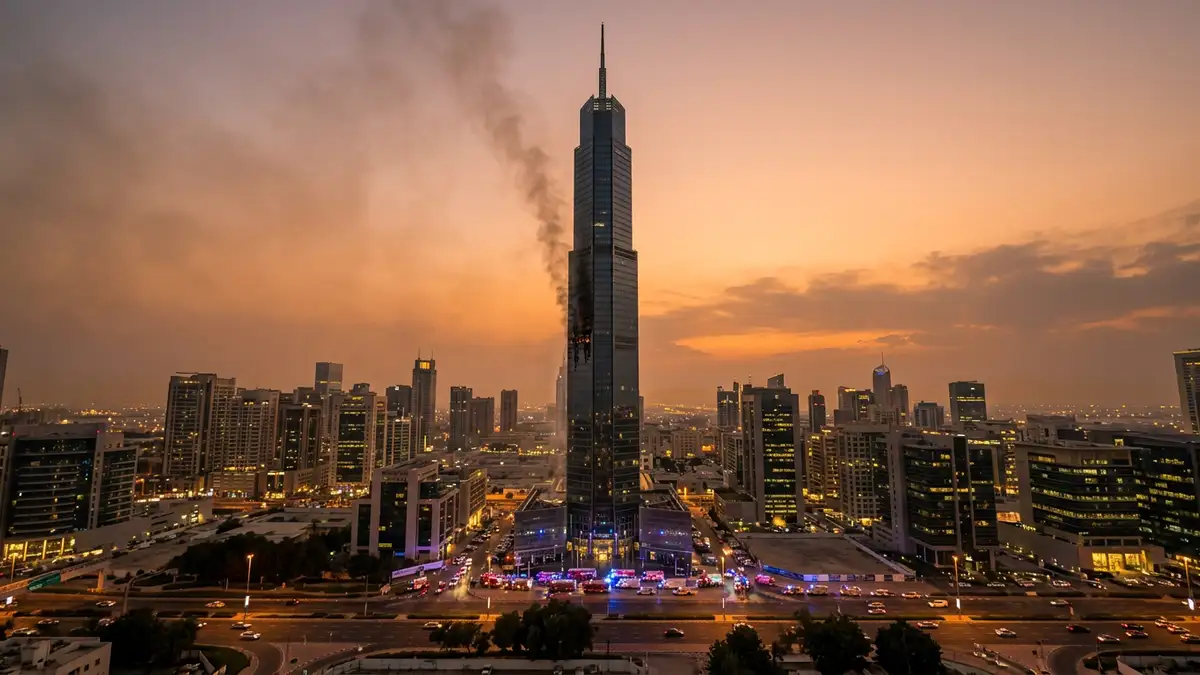
A Houthi drone attack on the Public Investment Fund Tower in Riyadh injured 11 people on 24 November 2026, the second strike on Saudi Arabia’s tallest building in less than a week. The assault on the Saudi capital’s financial heart has deepened fears that the Yemen war, reignited in July, is now a direct threat to the Gulf’s biggest economy and to global energy markets.
Saudi Civil Defense said the wounded included two Saudi citizens, two Indian nationals, three Nepali nationals and four Egyptian nationals. The Saudi-led coalition fighting the Houthis called the strike a “cowardly terrorist attack” and promised a “firm response”.
What happened at the Riyadh tower
The coalition spokesman, Major General Turki al-Maliki, said one of the towers in the King Abdullah Financial District had been hit and that the attacker used a drone. He did not name the building. Three separate witnesses told the AFP news agency, as reported by Al Jazeera, that the target was the 80-storey Public Investment Fund (PIF) Tower, which houses the headquarters of the kingdom’s sovereign wealth fund. At roughly 385 metres, it dominates the district’s skyline.
Saudi Civil Defense published a photograph showing damage about halfway up the facade. Reuters reported that the image resembled the damage from the earlier strike on the same tower on 19 November 2026, which caused damage but no injuries. Reuters said it could not immediately establish when the new picture was taken or how extensive the fresh damage was.
One detail stands out. A fourth witness told AFP that a vehicle fitted with a loudspeaker warned pedestrians to take cover, and that no alert was sent to mobile phones, as had happened during some recent strikes. Hong Kong broadcaster RTHK reported that workers were said to be repairing damage from the first attack when the building was hit again.
A campaign that keeps widening
The Houthis, an Iran-backed movement that controls much of western Yemen including the capital Sanaa, have fired at Saudi airports, oil infrastructure and office buildings since Yemen’s frozen civil war flared up again in July. Al Jazeera describes the revival as a knock-on from the wider US-Iran war.
CNBC reported that the group also targeted a Saudi oil refinery on Sunday 22 November 2026, and that it fired drones and ballistic missiles at airports, most recently at King Khalid International Airport on 25 October 2026. Wednesday brought a further escalation: Houthi military spokesman Yahya Saree warned on X that the port of Jeddah and all Saudi ports on the Red Sea coast would become “targets for our forces” if Riyadh attacked the Yemeni port of Hodeidah. The coalition had urged civilians to leave Hodeidah port for their own safety on 20 November 2026, according to CNBC.
Gulf allies and Washington react
Condemnation came quickly. The Gulf Cooperation Council’s secretary-general, Jasem Mohamed AlBudaiwi, called the strike a “heinous crime” and urged “a decisive international stance” to hold the group to account. Qatar described it as a “flagrant violation of Saudi sovereignty”, Kuwait warned of a “dangerous escalation”, and the United Arab Emirates, Bahrain, Pakistan and the United States also denounced the attack, according to Al Jazeera and the Saudi Press Agency.
US Secretary of State Marco Rubio spoke with Saudi Foreign Minister Prince Faisal bin Farhan Al Saud and condemned what he called Iran-backed Houthi terrorist attacks on Saudi civilian and energy infrastructure. The Indian embassy in Riyadh said it was seeking more details on its two injured nationals and would extend all possible assistance.
Why the strike on a financial district matters
The target is as significant as the casualty count. For years Riyadh has sold itself as a regional hub for finance, business headquarters and international events, part of the Vision 2030 programme to diversify the economy away from oil. Bloomberg described the attack as a further setback to the kingdom’s efforts to establish the capital as a global financial centre.
The disruption is already measurable. Al Jazeera reported that the attacks have led to the cancellation of most international flights to Riyadh and forced Saudi Arabia to postpone or cancel major international events, including football’s AFC Asian Cup. Saudi Arabia earlier cancelled its 2026 “Davos in the Desert” investment conference amid the attacks.
Investors will also watch the energy infrastructure. Saudi air defences intercepted drones over Ras Tanura in the Eastern Province, home to one of the world’s largest oil export terminals, according to coalition reports. The Houthis said they had targeted the refinery there, but there was no independent confirmation of damage.
The Yemen front and the wider Iran conflict
The fighting in Yemen is now closely tied to the confrontation between Iran and the United States. Bahrain, home to the US Navy’s Fifth Fleet, reported over the weekend that it was attacked by Iran, with two people injured at a civilian industrial facility, according to CNBC. In the Strait of Hormuz, Iranian state media reported that tankers hit naval mines, a claim we examined in our report on the Hormuz tanker incidents.
On the ground in Yemen the human cost is severe. Al Jazeera reports that hundreds of thousands of people have been displaced since July, that the Houthis have seized swathes of territory, and that forces aligned with the Saudi-backed government were forced into a major retreat this month. The coalition has carried out widespread air strikes. The United Kingdom also announced sanctions on four senior Houthi officials on 24 November 2026, Al Jazeera reported.
What a “firm response” could look like
The coalition has not said what its response will be. The most obvious flashpoint is Hodeidah, the Red Sea port the coalition has told civilians to leave. Any assault there would risk the very retaliation against Jeddah and other Red Sea ports that the Houthis have now threatened. Those ports matter far beyond Saudi Arabia because they sit on the shipping lanes that carry goods and fuel to Europe.
Analysts have long warned that every escalation by one side invites a larger one from the other. With Iran, the US and the Gulf states all drawn in, a miscalculation in Yemen could ripple into the Gulf’s oil flows and international shipping.
What it means for UK readers
Britain has direct stakes. UK sanctions on Houthi officials show London is already engaged, and the Red Sea and Gulf shipping routes carry a large share of the energy and consumer goods that reach British ports. Oil and gas prices are sensitive to any threat to Saudi export capacity or to tanker traffic, and that feeds through to household bills at a time when energy costs are already a political flashpoint. We argued in our comment piece on the energy price cap rise that families need more support this winter than the government has so far offered.
British nationals in Saudi Arabia, and companies with offices in Riyadh, will be reviewing their security arrangements. Anyone planning to travel to the kingdom should check the latest Foreign, Commonwealth and Development Office advice, given that most international flights to Riyadh have been cancelled.
What to watch next
- The coalition’s response, particularly any move on Hodeidah port.
- Whether the Houthis follow through on their threat to Jeddah and Red Sea ports.
- Further strikes on the King Abdullah Financial District or on energy sites such as Ras Tanura.
- Insurance and shipping costs through the Red Sea and the Strait of Hormuz.
- Any diplomatic push from Washington and Gulf capitals to contain the conflict.
For now, the picture is of a conflict moving from remote oil facilities and airports to the commercial heart of a G20 capital. Saudi authorities and the coalition blamed the Houthis directly for the 24 November strike. How Riyadh answers will shape whether the war stays regional or pulls in the wider Gulf. Manchester Times will continue to follow developments.


