




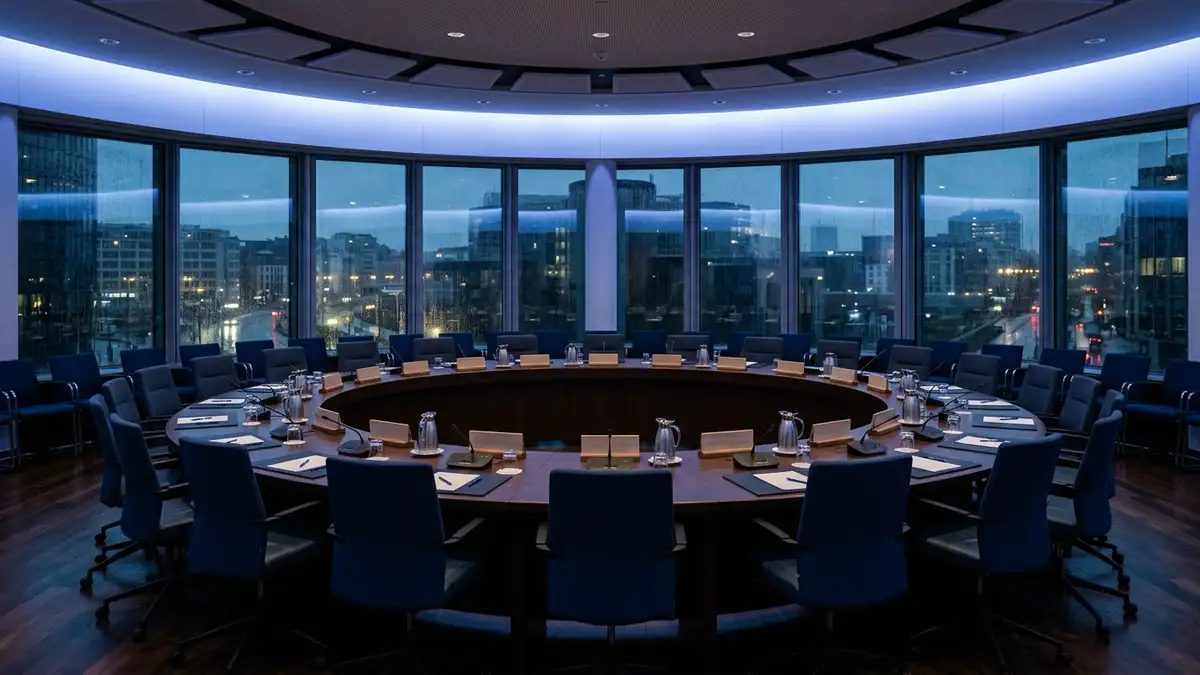
European Union leaders left Brussels on 26 November 2026 without an EU budget deal for 2028 to 2034 and without agreement on a €45bn (£37.6bn) loan for Ukraine, after a special summit that ran for more than 12 hours and ended in boycotts, public sniping and open doubts that a settlement is possible this year. The decisions now move to a regular European Council on 17 and 18 December 2026, with France saying that date is effectively the last chance.
For British readers the story matters on two fronts: the size of the bloc’s spending sets the tone for trade and regulatory dealings with the UK’s largest neighbour, and the Ukraine loan is a test of whether Europe can keep funding Kyiv as the war enters another winter.
What happened at the Brussels summit
The meeting was called by European Council President António Costa to break a long deadlock over the seven-year spending plan, formally known as the multiannual financial framework. According to BBC News, tense talks ended after 12 hours, with some members walking out of negotiations. A planned second day on Friday 27 November was scrapped, a decision Euronews reported dampened energy among delegations and lowered expectations early.
Costa had asked leaders to focus on three questions: the overall size of the budget, how money is divided between spending headings, and a package of new revenue sources. Afterwards he conceded plainly: “we did not reach an agreement”. He still insisted the bloc needs a new budget in place from 1 January 2028.
Euronews described a day of procedural manoeuvres. After leaders aired well-known positions in plenary, Costa split them into small groups: first the fiscally cautious “frugal” states, then the “friends of cohesion”, then the six largest economies, then mixed breakout sessions. The frugals, who felt singled out, boycotted the small-group format. The BBC reported that four countries seeking to rein in spending, including Denmark and Austria, walked out after several hours.
A split over the size of the budget
The central argument is simple: how much should the EU spend? The BBC reports that the divide runs between countries such as France and Italy, which favour a higher-spending plan, and those advocating restraint, with Germany chief among them. Higher-spending states want money to protect farming and fund regional development. Cautious states do not want to pile up debt.
The headline numbers depend on how they are counted. Euronews put Costa’s compromise at €1.78 trillion in current prices over seven years, around 10% below the original draft. The BBC said the proposal envisages cutting roughly €220bn to €230bn, leaving a total of €1.582 trillion, including €140bn to repay pandemic-era borrowing. Those figures use different baselines, so readers should treat each as the outlet’s own measure rather than a single agreed total.
Whatever the metric, nobody was ready to move. Euronews reported that Italian Prime Minister Giorgia Meloni arrived saying a deal was “light years away” and later said she had no time limit, only conditions: “When the agreement is one that I consider valid and fair for Italy, then I’ll sign it.” Dutch Prime Minister Rob Jetten, a staunch frugal, said there was “no need to hurry”. Hungarian Prime Minister Peter Magyar, quoted by Sight Magazine, said the chances of an agreement on the day were “virtually zero” and that a deal around Christmas looked unlikely too.
Macron’s ultimatum and the Le Pen factor
France’s President Emmanuel Macron raised the stakes with a rare mid-summit press conference. He said it would not be possible to reopen or conclude budget talks after 31 December 2026, warning that a drawn-out process would collide with France’s presidential election in 2027. “We can conclude by 31st December, but that is the absolute limit,” he said, while also calling the proposed cuts a “strategic mistake”.
The backdrop is Marine Le Pen, who leads opinion polls and, according to the BBC, announced last month that she would significantly reduce French aid to Ukraine and EU contributions if elected. Le Pen branded the talks “underhanded political manoeuvring”; Macron replied that it was “an odd kind of arrogance to behave as if she is already in charge of France’s destiny”. Other diplomats, Euronews noted, suspect Macron of using the threat of a future Le Pen presidency as a tactic to extract concessions. Greece’s Kyriakos Mitsotakis argued that failing to settle in December would make a deal “practically impossible” in the first half of 2027, as Italy, Poland and others also head to the polls.
Germany’s hard line
German Chancellor Friedrich Merz took a firmly frugal stance. Euronews reported he said the cuts would not stop at the €204bn Costa proposed: “It will become less.” He later spoke of “new movement” towards a smaller budget but added that “we are not there yet”. The rift between Paris and Berlin, the bloc’s two heavyweights, hangs over every other dispute.
The €45bn Ukraine loan stalls
Ukraine was meant to be a headline item, yet Euronews said the budget fight left it “relegated to an afterthought”. The proposal is for the EU to borrow €45bn and lend it to Ukraine for 2027, split between €20bn for civilian needs and €25bn for weapons and ammunition. France 24 reported that the loan would be borrowed against the EU’s current budget, which expires at the end of next year, and repaid only if Russia pays war reparations.
Costa said 24 of the 27 member states support it. Slovakia, the Czech Republic and Hungary still refuse to take part, according to the BBC. Bulgaria, which previously opposed the plan, said it would back only the non-military strand, which the BBC called a small sign of progress, and Prime Minister Rumen Radev said Sofia would not fund weapons, according to EUalive.
Merz drew a clear line: “I stand by my view that aid for Ukraine must be supported by the European Union as a whole. The European Union comprises of 27 member states, not 23 or 24.” On 27 November he added that some hesitant countries had ideas for sharing the burden and accommodating domestic politics, though “there is still no agreement.”
Other decisions in the room
The summit did settle one major appointment. The BBC reported that Spanish economist Pablo Hernández de Cos was named the next European Central Bank president, replacing Christine Lagarde from February 2027. The wider budget fight also lands amid fiscal strain: bne IntelliNews reported that twelve member states will run deficits above the EU’s 3% limit this year, with Bulgaria facing the first fine under the bloc’s fiscal rules.
What it means for the UK
Britain is not at the table, but it feels the effects. A fractious EU, preoccupied with its own money, has less appetite for fresh bargaining with London. The government is already working through the first agreements of its reset with Brussels; our report on the Cutting Costs Bill and the EU food deal explains how that is reaching Parliament. Trade friction beyond Europe is another strain, as our explainer on US tariffs on 14 trading partners sets out.
On Ukraine, the UK has stepped up its own support. The Argus daily briefing said Britain is supplying about 1,000 long-range attack drones worth £260m. A European funding gap would increase pressure on London and other non-EU allies to carry more of the load.
What to watch before 17 December
Three things will decide whether the December European Council succeeds. First, whether the frugals and the friends of cohesion can agree a number: Merz says a smaller budget is coming, Macron calls cuts a mistake. Second, whether the Ukraine loan can be arranged for a coalition of the willing if Slovakia, the Czech Republic and Hungary stay out, given Merz’s insistence on all 27. Third, whether France’s domestic politics harden any further as the presidential campaign nears.
The budget requires unanimity, so every national leader effectively holds a veto. One diplomat told Euronews: “You need to have a bad European Council to have a good one.” Costa will hope that proves right. For now, the EU enters December with no budget, no Ukraine loan and a deadline set by an election.


