




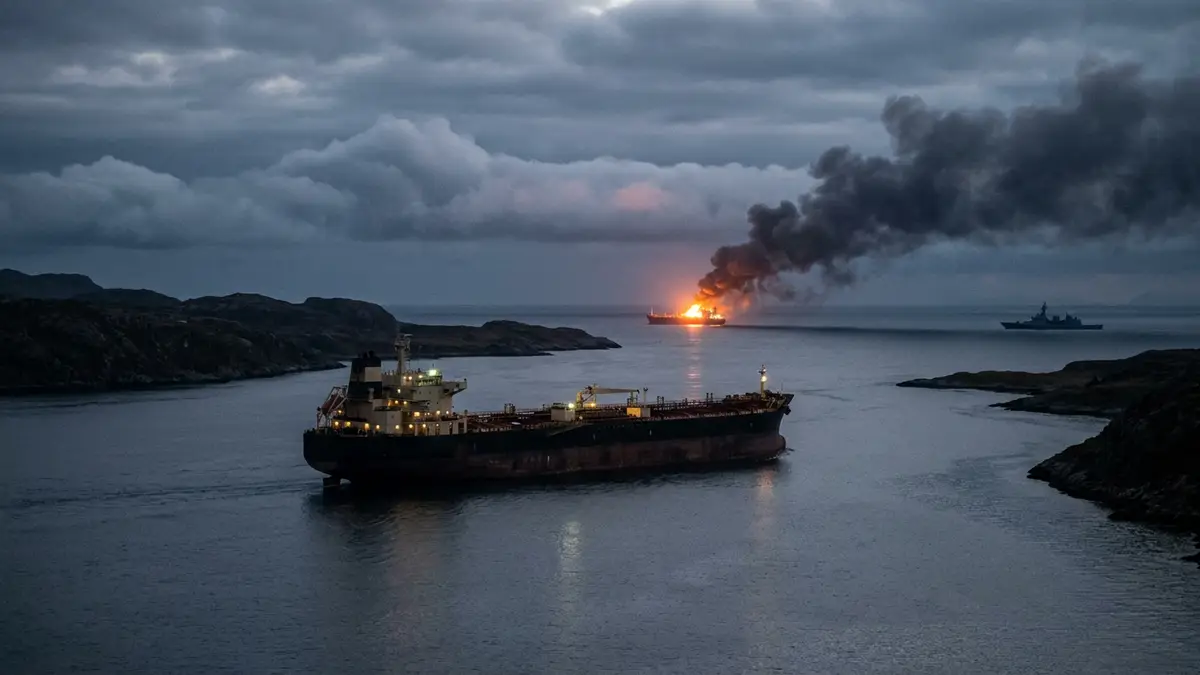
Three oil tankers caught fire in the Strait of Hormuz after hitting naval mines, according to Iran’s Revolutionary Guard Corps Navy, in the latest blow to the world’s most important oil shipping lane. The Strait of Hormuz tankers incident, announced late on Monday 23 November 2026, came despite what Tehran said was heavy US military air cover, and it landed on the same day Washington widened its financial sanctions on Iran.
The claims come from Iranian state media and have not been independently verified. But they fit a pattern that has built up over the past fortnight, and they matter well beyond the Gulf: for oil prices, for insurance costs and, eventually, for what British drivers and households pay.
What Iran says happened to the tankers
In a statement carried by the state news agency IRNA, the Guards said three “offending” tankers suffered “a severe explosion and fire after hitting naval mines”, as reported by CNBC. One vessel was said to be near the southern coast of the strait, and two in its eastern part. All three, the statement claimed, were operating under extensive US military air cover and escort that “failed to prevent the explosions”.
The Guards added that US cover “will not replace compliance with maritime regulations and instructions” from their own traffic control centre. Anadolu Agency, in its morning briefing for 24 November 2026, reported the same account and said the Guards warned ships against taking “unauthorised routes” and ignoring maritime warnings. The Guards also said they would release footage of the blasts.
No shipping company, flag state or independent maritime body had confirmed the details at the time of writing, and the names and cargoes of the vessels were not given. Readers should treat the specifics as Iran’s account until the owners, insurers or the UK Maritime Trade Operations centre say more.
A pattern that has been building since mid-November
This was not an isolated event. On 17 November 2026, CNBC reported that the Iranian navy claimed four tankers had struck mines and caught fire in the eastern strait over the previous 24 hours. On the same day the UK Maritime Trade Operations agency, which is run by the Royal Navy, said a tanker had been hit by an unidentified projectile in the strait and caught fire. It did not say who was responsible and urged vessels to transit with caution.
Iran has repeatedly told commercial ships that only the northern shipping lane has Tehran’s approval for safe passage. The Guards have called the US-backed southern route through the strait fully closed and a “minefield of fire”, and Iranian army spokesman Brigadier General Mohammad Akrami-Nia said the strait would not reopen until “the enemy accepts Iran’s conditions”.
The background is a conflict now in its ninth month. CNBC dates its start to late February 2026, when the United States and Israel struck Iran and Tehran retaliated against Israel and Gulf states hosting American bases. Anadolu reports that Iran announced the closure of the strait on 12 July 2026, after the US resumed military strikes. Since then the United States has enforced a naval blockade of Iranian ports, and a third American aircraft carrier, the USS Theodore Roosevelt, arrived in the Gulf region on Sunday 15 November 2026 to join the USS George H.W. Bush and USS George Washington.
Sanctions and cyberattacks add a second front
The mine claims were announced hours after the US Treasury unveiled a new round of sanctions on Monday 23 November 2026. According to Al Jazeera, the measures hit more than two dozen Iranian exchange houses, front companies and key personnel, in what the Treasury called “a sweeping effort to disrupt Iran’s global shadow banking networks”. Treasury Secretary Scott Bessent described that system as “the last financial lifeline of a bankrupt regime”.
Named targets included Mina Fashki and Partners Exchange Company and Mellat Exchange Company, along with a Qeshm-based firm that the Treasury says worked with exchange houses to move money for Iranian petrochemical companies. Washington says its pressure campaign, which it calls Operation Economic Outcast, has pushed the Iranian rial to record lows and driven inflation to around 90 per cent. Those are US government claims and have not been audited independently.
There is also a digital dimension. The Wall Street Journal reported on Monday, as summarised by CNBC, that Washington is investigating Iran as a primary suspect behind dozens of cyberattacks on energy tankers. As many as 50 ships carrying oil, liquefied petroleum gas, chemicals and other hazardous cargoes were believed to have been targeted, some receiving warnings, bomb threats or ransom messages. US officials were also examining Russia as another possible culprit, and neither foreign ministry responded to CNBC’s requests for comment.
Diplomacy is stuck, and Trump has set a deadline of sorts
Talks are going nowhere fast. Iranian state media say Tehran’s conditions for negotiating include lifting sanctions, ending the US naval blockade of Iranian ports and releasing seized Iranian assets. The Associated Press reported on 24 November 2026 that Iran rules out talks with the US until its seven conditions are met, though Iranian authorities have not publicly listed them all.
Washington has shown little appetite to accept those terms, while insisting Iran cannot have a nuclear weapon. Al Jazeera reported that Foreign Minister Abbas Araghchi said Tehran still hopes diplomacy can end the war, while President Donald Trump said Iran wants a deal that is not acceptable to him. Fox News quoted Trump as saying he is “inclined to order military strikes against Iran after the new year” if no agreement is reached.
Ian Bremmer, president of the Eurasia Group, told CNBC last week that Iran is likely to keep escalating attacks on tankers and container ships to pressure Washington into concessions, and that Washington would probably respond by expanding its blockade. He called the US assumption that Iran will eventually crack under economic strain a “misread of the Iranian leadership and their capacity to resist”.
Why oil prices have barely flinched
Given the headlines, the oil market’s reaction has been muted. CNBC reported that on Tuesday 24 November 2026 Brent crude futures dipped to $89.2 a barrel and US West Texas Intermediate fell to $80.1, well below an October high of almost $105. Gregory Brew, senior analyst for Iran and energy at Eurasia Group, said pressure on prices has eased as regional supply recovered and Russian exports rebounded ahead of winter. Russian diesel shipments, he said, were back up to 400,000 barrels a day in November.
Brew also warned that “intensifying Iranian attacks in the Strait of Hormuz could reverse that trend”, and estimated Brent would stay in the lower half of an $80 to $100 range. In other words, traders are pricing in a damaged but functioning market, not a fresh shock. A confirmed, serious attack on a loaded tanker, or a spike in war-risk insurance, could change that quickly.
What it means for UK drivers and households
Oil is priced globally, so disruption in the Gulf can feed into what UK drivers pay at the pump and into wholesale gas and shipping costs. For now, the benign oil price is good news. The RAC has said petrol could fall below 150p a litre as wholesale costs ease, as we reported in our story on petrol prices and the RAC forecast. That outlook assumes the Gulf does not deteriorate sharply.
The risk is asymmetric. Falling prices are gradual, while a sudden escalation can lift wholesale costs within days. Markets are also on edge elsewhere: our report on the Bitcoin price falling below $60,000 shows investors retreating from risk assets this week.
For Greater Manchester businesses that depend on imported goods, freight and fuel, the practical signals to watch are simple: Brent crude moving back above $95, announcements of higher war-risk premiums for Gulf cargoes, and shipping lines rerouting or pausing services.
What to watch next
- Independent confirmation. Whether tanker owners, insurers or the UK Maritime Trade Operations centre verify the Guards’ account of the three explosions.
- US response. Washington has not, at the time of writing, publicly answered Iran’s claim that its air cover failed.
- Talks through Qatar. Indirect negotiations have stalled over Iran’s conditions, and any movement on the blockade would be the clearest sign of a thaw.
- The new year. Trump’s reported willingness to order strikes after the turn of the year gives both sides a looming deadline.
- Oil and insurance. Brent’s range, and the cost of covering ships that use the strait, will show how seriously markets take the latest incidents.
Until one side moves, the strait is likely to stay what it has been for months: open in theory, risky in practice, and a daily test of whether a war that both sides say they want to end can be stopped before it widens.


