




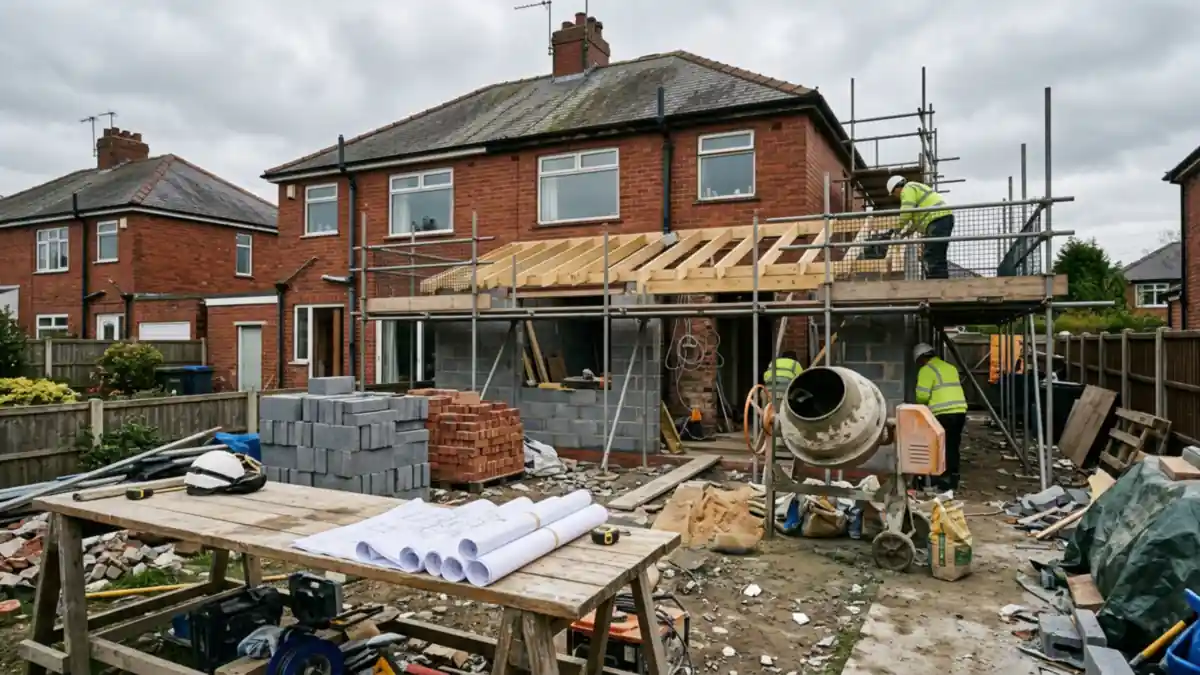
Planning fees in England are going up again on 8 December 2026, the second rise this year, and homeowners preparing to apply for an extension, loft conversion or other alterations have just under two weeks to submit under the current charges. The change, set out in regulations made on 10 November, arrives only weeks after a separate shake-up handed decisions on most household applications to council planning officers rather than committees of councillors.
Taken together, the two reforms change both what it costs to apply and who decides. Here is what is changing, what stays the same, and what it means for anyone in Greater Manchester planning to improve their home in 2027.
How much planning fees are rising
The new charges are set out in amending regulations to the planning application fees rules, numbered SI 2026/1192 and published on legislation.gov.uk. The government says the higher fees are intended to help councils recover around 90 per cent of the cost of processing applications.
For a typical householder, the increase is modest. For anyone needing extra approvals, or building new homes, it is much larger. According to an analysis by the planning consultancy Planning Geek, the main changes are:
- Householder planning application for an extension or alteration to a single house: up from £548 to £575.
- Larger home extension prior approval under permitted development: up from £249 to £310.
- Discharging conditions on a householder permission: up from £89 to £125.
- Non-material amendments to a householder permission: up from £46 to £53.
- A new home, for schemes of fewer than ten dwellings: up from £610 to £752 per home.
- Permission in principle: the old area-based charge is replaced by a flat fee of £825.
Some applications under permitted development rules that were previously free will also attract a new £310 charge. On top of the December rise, a further inflation-linked increase is already scheduled for 1 April 2027.
The deadline that matters: 8 December 2026
The regulations include transitional protection. Broadly, an application made before 8 December is charged at the old rate, while anything made on or after that date pays the new fee. The key word is “made”. A council will normally treat an application as made only when it is valid, with the right forms, drawings, ownership certificate and fee. Rushing in an incomplete submission to beat the deadline could backfire if the council later asks for missing documents and a fee top-up.
For most homeowners, the extra £27 on a standard householder application is unlikely to change whether a project goes ahead. The larger percentage rises on prior approvals and conditions matter more, because a single extension can involve several separate submissions over its life: a prior approval or full application, then one or more requests to discharge conditions on materials, drainage or landscaping, and possibly a non-material amendment if the design changes on site.
Who now decides a householder planning application
The second big change has already happened. Since 31 October 2026, a new National Scheme of Delegation has applied across England. Under the Town and Country Planning (Discharge of Local Planning Authority Functions) (England) Regulations 2026, councils must have a planning officer decide householder applications, minor commercial schemes and small housing developments of up to nine homes on sites under half a hectare, rather than sending them to a planning committee of elected councillors, except in narrow circumstances. The same applies to prior approvals and lawful development certificates.
Announcing the change, the Ministry of Housing, Communities and Local Government said straightforward applications would no longer have to wait for a committee slot. In its press release of 30 October 2026, the department said householder applications account for nearly 70 per cent of all planning applications each year. Housing Secretary Angela Rayner said families wanting more space should not be left waiting unnecessarily for straightforward decisions.
Some councils have flagged a loss of local scrutiny. Ward councillors in many areas can no longer “call in” a neighbour’s extension for a public debate at committee, and some planning agents have warned that the route of appeal to councillors, used occasionally when an officer was minded to refuse a reasonable scheme, has effectively gone. Applicants who are refused still have the right of appeal to the Planning Inspectorate.
Rochdale among councils testing AI planning tool
The government is also rolling out an artificial intelligence system called PlanAssist, built with Google DeepMind, Google Cloud and the technology firm Faculty. It pulls together the application, local policies and site constraints so that an officer can review a case more quickly. Early trials in Camden, Barnet and Dorset cut the time spent on key tasks by 58 per cent, according to the government, which says it hopes to halve processing times for routine householder applications from eight weeks to four.
Rochdale Borough Council is one of 12 additional councils now testing the tool for a year, alongside authorities including Newcastle, Nottingham, Bristol, Cumberland and Westminster. Officers remain responsible for decisions, and the government intends to make the tool available to every council in England by the end of 2027. Rochdale’s planners already have a busy caseload, with major regeneration such as the plan to replace the Seven Sisters tower blocks with 600 new homes.
What has not changed: permitted development rights
Despite talk of reform, the basic permitted development limits for houses in England have not been relaxed this year. Many extensions still do not need a full planning application at all. Under the current rules, as summarised in government technical guidance:
- A single-storey rear extension can usually project up to 4 metres on a detached house or 3 metres on other houses, with a maximum height of 4 metres, without a planning application.
- Under the larger home extension prior approval route, this rises to 8 metres for detached houses and 6 metres for others, provided the council does not object after neighbours are notified. This is the route whose fee rises to £310.
- Loft conversions are commonly permitted development within volume limits of 40 cubic metres for terraced houses and 50 cubic metres for detached and semi-detached homes, subject to conditions on materials and position.
- Permitted development rights do not apply to flats, and are restricted in conservation areas and where a council has made an Article 4 direction.
Planning proposals floated in 2024 to allow longer rear extensions on terraced houses and to scrap the loft volume cap have not been enacted. Separately, a change to permitted development made in November 2026 mainly covers electric vehicle charging, including allowing cross-pavement charging solutions outside homes in some cases.
Lawful development certificate: worth the fee?
If you believe your project is permitted development, you do not have to apply for anything. But many homeowners choose to get a lawful development certificate, which confirms the work is lawful and can smooth a future sale. Some certificate fees are calculated as a share of the equivalent planning application fee, so they will also rise from 8 December. Anyone planning to build in spring may want to apply for a certificate now.
What homeowners in Greater Manchester should do now
The North West’s large stock of Victorian terraces and inter-war semis means rear extensions, side returns and dormer loft conversions are among the most common applications received by councils from Bolton to Stockport. For anyone in that position, the practical advice is:
- Check whether you need an application at all. The Planning Portal’s interactive guides and your council’s website set out permitted development limits. If your house is in a conservation area or covered by an Article 4 direction, assume you will need permission.
- If you are ready, submit before 8 December 2026. Make sure the application is complete and valid, with the fee paid, so it is treated as made under the current charges.
- Budget for the whole process. Allow for discharge of conditions, possible amendments and building regulations approval, which is a separate process with its own charges.
- Talk to neighbours early. With fewer routes for objections to reach a committee, raising concerns early with a neighbour is often the quickest way to avoid delay and disputes.
- Remember the Party Wall Act. Work on or near a shared wall or boundary may need formal notice to neighbours regardless of planning permission.
Faster decisions, higher costs
The government’s argument is that homeowners will accept slightly higher planning fees if decisions arrive more quickly and reliably. Whether that happens will depend on councils using the extra income to hire and keep planners. Ministers say 420 new planners have been recruited through government-backed programmes so far, beating a manifesto pledge of 300, with a target of 1,400 by the end of the Parliament.
For now, the immediate point for homeowners is the date. Anyone with drawings ready for an extension or loft conversion has until 7 December 2026 to apply under the current planning fees, and from 1 April 2027 costs are scheduled to rise again.

