




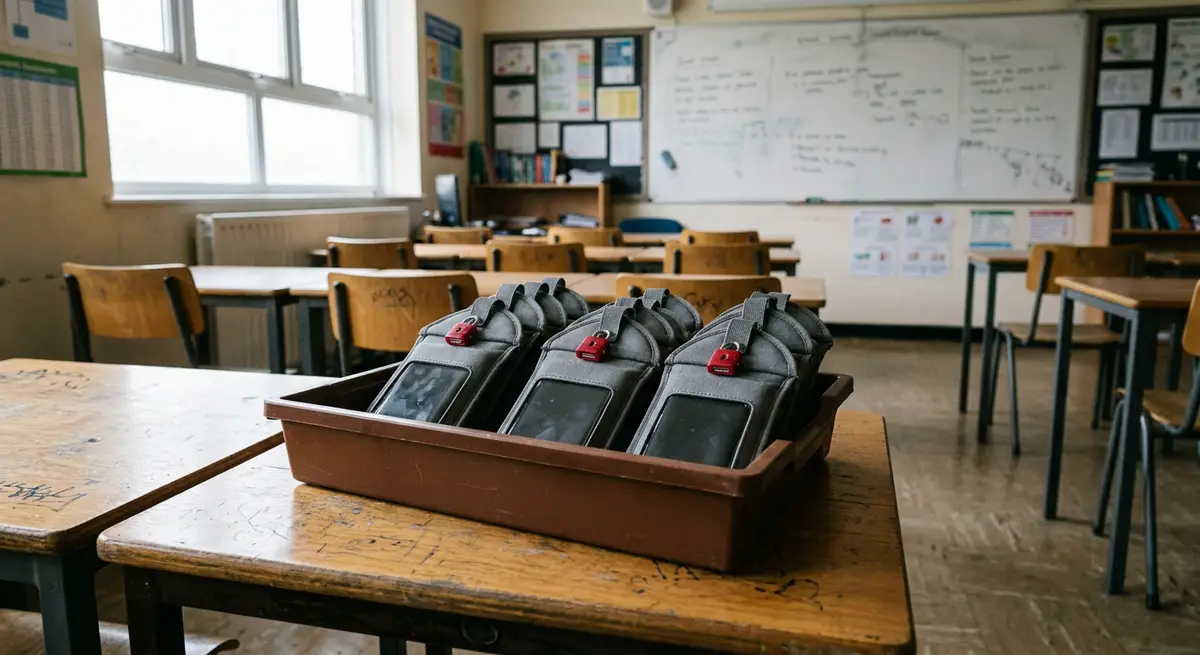
Pupils in England will not be allowed to have their mobile phones on them at any point in the school day under tougher rules announced by the Department for Education, ending the “not seen, not heard” approach that many secondary schools rely on.
The strengthened statutory guidance, which ministers say will take effect from September 2027, tells schools to adopt whole-school systems that keep phones out of use and out of reach from the moment pupils arrive until the end of the day. That could mean lockable pouches, collecting handsets at the gate, secure storage, or banning phones from the site altogether.
Education Secretary Lucy Powell said in the government announcement: “Children should not be using smartphones at any point during the school day, full stop.”
Why ministers are going further
Guidance that came into force in June already made schools and trusts responsible for running a phone-free school day, but left headteachers to decide how. Under many existing policies, phones can stay switched off in a bag as long as they are not seen or heard.
The government argues that this has not worked well enough. It says only 16% of secondary pupils report that phone rules are followed all of the time. It also points to polling suggesting 40% of children aged nine to 16 were turning down real-world activities to spend time online, and to evidence from the interim Milburn review on youth unemployment that some pupils described staying up until 3am scrolling.
The Children’s Commissioner for England, Dame Rachel de Souza, welcomed what she called strong action to stop phones disrupting the school day.
Polling by Teacher Tapp in September, reported by Tes, suggested just over half of secondary schools currently use an “out of sight all day” policy, while roughly a third already collect phones or use pouches or lockers.
What it means for Manchester readers
Some Greater Manchester schools are already running the kind of system ministers now want to see everywhere. Karl Harrison, headteacher at Burnage Academy for Boys, told BBC Breakfast that the school had spent £20,000 on metal detectors and phone pouches to stop pupils reaching their devices.
He said some pupils felt they had lost a freedom, but that pupils were socialising more. “People now can talk to each other, instead of scrolling on a device,” he said, adding that focus in lessons had improved.
For families across the region, the practical change is likely to be a phone handed in or sealed away at the start of the day rather than carried in a blazer pocket. Schools will still decide exactly how to comply, so arrangements may differ from one school to the next.
The funding question
Headteachers’ unions broadly accept the aim but say the more robust options cost money that schools do not have. Paul Whiteman, general secretary of the NAHT, said going beyond “not seen, not heard” “comes at a cost”, and that schools would need extra funding and support.
Pepe Di’Iasio, general secretary of the Association of School and College Leaders, said the guidance “does at least provide some clarity”, but warned: “School leaders cannot simply make mobile phones disappear.” He said that if every school were expected to provide lockable pouches or secure storage for every pupil, the cost would be “very significant indeed”.
The DfE announcement did not include new money for pouches or lockers. Asked about funding, Ms Powell told the BBC she wanted heads to have the freedom to choose the approach that works best for their school.
Campaigners were more enthusiastic. Charlotte Ashton, co-founder of Generation Focus, said existing policies were failing and that pupils were still “TikToking in the toilets”.
What happens next
The revised wording of the guidance has not yet been published, and the changes are not due to apply until September 2027, giving schools around ten months to plan. Ofsted has been asked to look at phone policies during inspections since April.
Alongside the phone rules, the DfE has opened a consultation, running until 4 February 2027, on a safety certification scheme for education technology and AI products used in schools.
The rules apply to England only. Scotland, Wales and Northern Ireland are each consulting on or setting their own approaches. Separately, a UK-wide ban on social media for under-16s is due to be introduced in March.

