




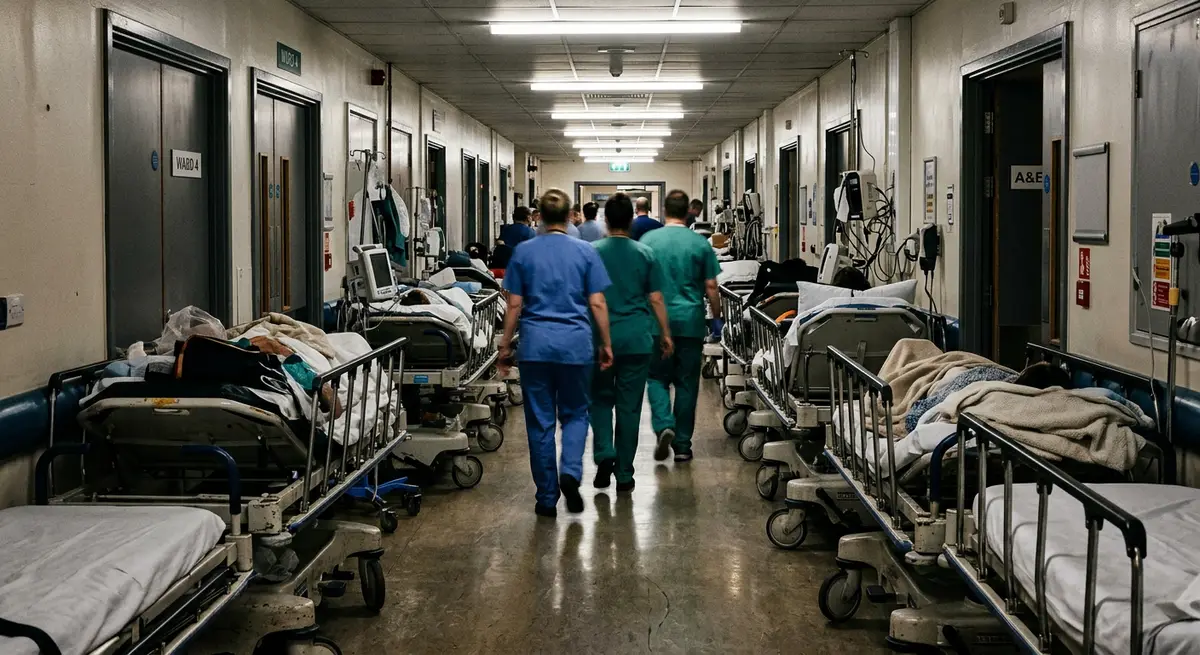
Emergency departments are entering winter already under severe pressure, senior doctors have warned, with new figures showing record attendances in England and a rise in the longest waits across Greater Manchester.
Dr Ian Higginson, president of the Royal College of Emergency Medicine, told the Commons Health and Social Care Committee that hospitals were going into the busiest time of year with 1,000 fewer beds than last winter.
“We are going into winter with our departments in big trouble already, and many on their knees,” he said, according to The Independent. “Our patients are still in corridors.”
Record demand before the cold sets in
The warning came as NHS England published performance data showing October was the busiest month on record for A&E, with more than 2.5 million attendances. Ambulance crews also had their busiest month, responding to almost 870,000 incidents, an average of 28,046 a day, according to NHS England.
Corridor care also hit a new high. An average of 3,558 patients a day were treated in corridors or makeshift areas in October, 2,718 of them in emergency departments, the highest since the figures began in May, PA Media reported. Nationally, 74.0% of A&E patients were seen within four hours, slightly down on September.
Dr Higginson said a poll of leading A&E doctors found two-thirds rated their department fairly or very unsafe, and almost nine in ten said it was under more strain than a year ago. He described the picture across England bluntly: “There are islands of excellence in the midst of a sea of doom.”
He also argued that the coming surge of winter viruses was entirely predictable. “This winter, more patients will get respiratory illnesses; there will be flu, there will be RSV, there will be norovirus,” he told MPs. “We know that’s going to happen, all we need to do is accept that and plan for it.”
What it means for Manchester readers
Figures analysed by the Manchester Evening News show that 3,587 patients at A&Es across Greater Manchester waited more than 12 hours from a decision to admit to actually being admitted in October. That is up from 3,081 a year earlier, although below the peak of 4,608 recorded in January 2025.
Just over half of attendances at the region’s major Type 1 emergency departments were dealt with within four hours, well below the national average, and little changed on last year.
There is better news on planned care. The Greater Manchester waiting list fell to just under 441,000 in September, down from about 467,000 a year earlier and far below the July 2023 peak of 525,000. Nationally, however, the waiting list rose for a third month in a row to 7.38 million treatments.
For patients, the practical message from the NHS is to use 999 and A&E for life-threatening emergencies and to turn to pharmacies, NHS 111 and 111 online for less urgent problems. Getting a flu or Covid-19 vaccine, if eligible, is also being pushed as a way to keep people out of hospital.
Government response and criticism
Health minister Karin Smyth told the committee that winter planning had begun in May and that the NHS was “a very pressurised system”. The government has announced £40 million in repurposed GP funding to identify and support frail and elderly patients most at risk of becoming seriously ill, alongside an expansion of the Pharmacy First scheme.
Health Secretary Yvette Cooper said: “As we head into winter, those pressures will increase.” Critics argue the money arrives too late. Dr Higginson said much of what was needed was long-term and “too late to make an impact this winter”, while Sarah Scobie of the Nuffield Trust said: “Progress on bringing down the waiting list has ground to a halt and the NHS is creaking at the seams as it heads into winter.”
Professor Nicola Ranger, general secretary of the Royal College of Nursing, called the corridor care figures “a mark of shame”.
What happens next
The Royal College of Emergency Medicine has urged ministers to open all available beds now, end recruitment freezes and ensure key services such as pharmacies are open 12 hours a day, seven days a week.
Flu has now risen above baseline levels in England, and colder weather is adding to demand in the North. November’s A&E figures, due in December, will give the first clear picture of how Greater Manchester’s hospitals are coping as winter takes hold.


