




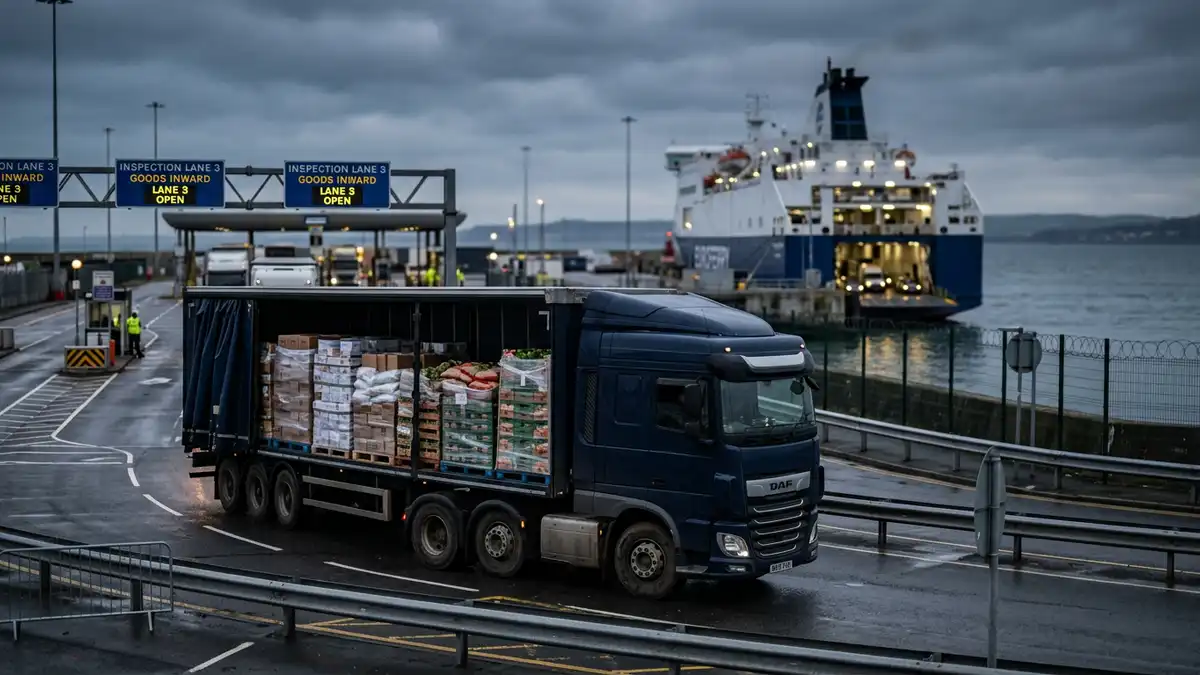
The Cutting Costs Bill, the legislation that would put Andy Burnham’s food and emissions deals with Brussels into UK law, was formally introduced to Parliament on Thursday 26 November 2026. The government has also published the treaty texts behind it. MPs will hold the first Commons debate on the draft law on 7 December 2026, with a vote expected to follow, according to the Press Association.
The bill matters because it turns a summit announcement into something that can be amended, opposed and, eventually, repealed. It also puts a spotlight on the clause critics have nicknamed the “Farage clause”, a 10-year termination provision that could leave Britain paying if a future government walks away.
What the Cutting Costs Bill does
The bill implements two of the three agreements struck at last week’s UK-EU summit in Brussels. The first is the sanitary and phytosanitary (SPS) deal, which is designed to end most post-Brexit checks on food and drink products. The second links the UK to the EU emissions trading system (ETS), which ministers say will remove a further trade barrier and protect billions of pounds of British exports from carbon charges.
Under the food deal the UK will align with EU rules in certain sectors. The government argues most British exporters already meet the bloc’s standards, and says the deal will remove the need for “Not for EU” labels on most products, as reported by the Independent using Press Association copy.
The European relations minister, Hamish Falconer, said the bill “allows us to eliminate paperwork for our food and drink traders” and makes doing business with Britain’s largest trading partner “cheaper and easier”. A Labour spokesperson said the changes would boost the economy by up to £17 billion and are backed by major supermarkets.
Dynamic alignment and parliamentary scrutiny
One of the most contested elements is how the UK will keep pace with EU rules. The Guardian reports that the bill contains powers allowing the government to align dynamically with Europe in areas where agreements already exist. It would also let the UK implement evolving single market rules quickly, where ministers judge it in the national interest, without full parliamentary scrutiny each time.
Officials say the UK will be “consulted early” on new rules and that the bill gives Parliament oversight of changes. Critics are likely to test how meaningful that oversight is, because the Guardian revealed in April 2026 that ministers had been planning legislation that would see Britain adopt single market rules without a normal vote.
Why alignment is the central argument
Supporters see alignment as the price of frictionless trade in food, where inspection delays can ruin perishable goods. Opponents see it as handing Brussels control over a sector that is Britain’s largest manufacturing industry, a point pressed by the Daily Express in its coverage of the bill. Both descriptions are accurate about the mechanism; they differ on whether the trade-off is worth it.
The 10-year termination clause
The treaties carry a 10-year termination clause. The BBC reported on Thursday that if one party ended an agreement, it would have to pay to rebuild border-check infrastructure. That has been labelled the “Farage clause” in some coverage, because the Reform UK leader has suggested he would refuse to pay and would renege on the deal if he won power, arguing that Burnham “cannot bind a future British government”.
Conservative leader Kemi Badenoch has described the package as a “terrible deal” that she would scrap. Reform’s position and its wider election pact questions are covered in our earlier piece on the Farage Restore Britain pact.
The clause cuts both ways politically. For Labour, it is an assurance to Brussels and to businesses that the arrangement will last. For opponents, it is evidence that a future government would face a financial penalty for changing course, which they say is an affront to parliamentary sovereignty.
Will food prices fall?
The government says the deals will “lighten the load on shoppers” and expects businesses to pass on cost savings. The Conservatives dispute the scale. Shadow Treasury minister Richard Fuller said Burnham was asking families to celebrate “savings of a few pennies on their weekly shop”, adding that new packaging rules could add “up to £1 a week” to shopping bills. The Tories also cite 2023 research suggesting the impact of post-Brexit border checks on prices was “not significant”.
Both claims are forecasts rather than measured outcomes. Until the impact assessments the government is expected to publish are scrutinised by independent economists, shoppers should treat headline figures on either side with caution.
The tuition fees problem
The package has a loose thread. Fears persist that the three deals, which include a youth mobility scheme allowing 100,000 young Britons to live, work, study and travel in the EU with reciprocal access for Europeans, could be derailed within six months unless the UK lets European students pay domestic-level university fees, the Guardian reports.
On Wednesday 25 November 2026 Burnham indicated European students would pay higher fees than UK students. At Prime Minister’s Questions Badenoch said he had given “no answer” on whether the deal depends on a tuition fees agreement. Burnham replied that it was “on a separate piece of paper, a separate deal” and that reducing EU students’ fees to UK levels “won’t be on the table”. Negotiations continue.
The politics of rejoining
Burnham has said he would like to see the UK rejoin the EU in his lifetime, but he has played down full integration since the deal, calling it “not a prelude to anything” and saying it would be “unthinkable” to rejoin without another referendum. We examined that promise in our opinion piece on the referendum pledge.
What happens next
- 7 December 2026: second reading debate in the House of Commons, announced by Commons Leader Alan Campbell.
- Impact assessments on sectors and regions are expected to be published alongside the bill.
- Talks on student fees continue, with the youth scheme tied up in the wider package.
- A third legal text, on youth mobility, was not among the two treaties published on Thursday.
What it means for UK readers
For households, the practical effect depends on whether exporters and supermarkets actually pass on savings. For food producers in Greater Manchester and the wider North West, the bill promises less paperwork on exports to the EU, but alignment with Brussels rules will shape what they can make and how. For voters, the larger question is whether a deal legislated by one government can survive the next.
The coming weeks will show whether Labour can hold its own MPs together and whether the Conservatives and Reform can turn the termination clause and the cost of living into a decisive argument against the package. The 7 December vote will be the first real test of Parliament’s appetite for Burnham’s reset.
Background on the original deal is available in the Guardian’s explainer.


