




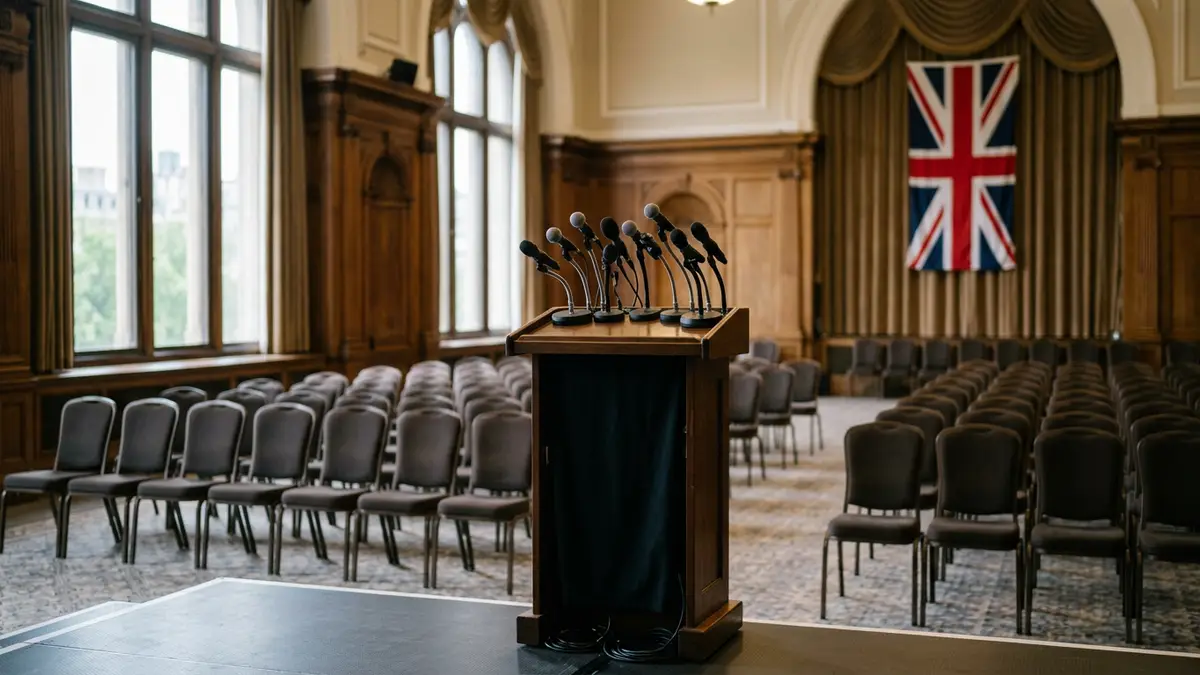
Reform UK will not strike an electoral pact with Restore Britain while the smaller party keeps some of its current backers close, Nigel Farage said on 24 November 2026. The Reform leader told a press conference in London that he might have a “civil chat” with Rupert Lowe, but that no Farage Restore Britain pact was possible unless Restore cut loose supporters he accused of promoting antisemitism and race-based ideas of nationality.
The remarks matter because they land at a delicate moment for the British right. Reform has slipped in the polls, Restore is picking up a slice of the same voters, and some people inside Reform’s Millbank headquarters have been openly weighing whether peace with Lowe would be cheaper than war.
What Farage actually said about Restore Britain
According to the Guardian’s report of the event, Farage was asked whether he would “kiss and make up” with Lowe, the Great Yarmouth MP who left Reform after a bitter falling-out and went on to found Restore Britain. His answer was typically blunt: he does not “kiss chaps all that much”, though a civil conversation was not out of the question.
The warmth ended there. Farage named two figures linked to Restore, the commentator and cleric Calvin Robinson and the campaigner Steve Laws, and said he could not imagine sitting down with either. He argued that Lowe “should be disavowing these people” and that an electoral pact with an organisation that had such figures “relatively senior within it” was a non-starter. He added that he doubted anyone on Reform’s front bench would want him to go down that path.
The door, however, was left slightly ajar. A day earlier Farage had said that if Lowe were to get rid of those people, it would be “a different kettle of fish”. In other words, the condition is political rather than personal, and it is one only Lowe can choose to meet.
Why a Reform and Restore deal was even on the table
The idea did not come from nowhere. On 21 November 2026 the Guardian reported that senior Reform sources were considering a pact with Restore as a way to arrest a stall in the party’s polling. One source described a “non-aggression pact” as an option, while another camp inside the party argued for attacking Restore head on and winning back its voters.
Reform’s own people have been keen to dampen the story. The party’s deputy leader, Richard Tice, told Sky News on 22 November 2026 that Reform was “not doing a deal with anybody” and was “not doing a deal with Rupert Lowe”. Reform’s director of local government, Jaymey McIvor, told GB News there were no official talks under way. On the Conservative side, deputy leader Alex Burghart said a pact with Restore was “very, very unlikely” given its line on ethno-nationalism.
Yet pressure from outside Reform has not eased. The commentator Matt Goodwin, who stood for the party in the Gorton and Denton by-election, called publicly for tactical cooperation, arguing there was no time for division on the right. UnHerd has also run a column urging both sides to deal, noting that Restore is polling at around 4 per cent and that its attacks on Reform risk alienating Reform’s own supporters.
The polling problem behind the pact talk
Several recent polls have placed Reform third, behind Labour under Prime Minister Andy Burnham and the Conservatives, with support in the high teens. That is roughly ten points below where the party stood a year ago, according to the figures cited by the Guardian and repeated by outlets including Left Foot Forward.
Personal ratings are no kinder. An Ipsos poll of 1,137 British adults, conducted online between 6 and 9 November 2026, found 22 per cent had a favourable view of Farage and 62 per cent an unfavourable one. That is a net rating of minus 40, his lowest since he won Clacton in July 2024, according to HuffPost UK’s reading of the data. Only Donald Trump scored worse among the politicians tested.
Restore’s first modest electoral breakthrough has added to the nerves. The party won the Gunton ward by-election on Lowestoft Town Council in the week before Farage spoke, its first win outside Lowe’s own constituency, according to London Loves Business. A parish-level victory is small, but for a party that barely existed a year ago it is a talking point, and it feeds the narrative that the right is fragmenting.
Why vote-splitting matters under first-past-the-post
Britain’s voting system punishes divided camps. In a constituency where the right-of-centre vote is spread across three parties, a candidate from a single rival can win on a minority share. Analysts have noted that the Conservatives and Reform sit on near-identical shares nationally, and former prime minister Theresa May rejected the case for any Conservative-Reform alliance on 22 November 2026.
Adding Restore to the mix makes the arithmetic harder still. Even a party at 4 or 5 per cent can swing marginal seats if its voters would otherwise have backed Reform. That is the logic of the “non-aggression pact” idea: not a merger, but an agreement not to stand against each other where it would hand a seat to someone else.
Farage’s problem is that any such arrangement requires trust and shared red lines. By publicly tying a deal to the removal of particular individuals, he has made it hard for Lowe to agree without appearing to bow to his former leader.
Brexit and the Conservatives: Farage’s other targets
The press conference was billed as a Brexit event at Church House in Westminster, and Farage used it to attack Burnham’s approach to Europe. The Prime Minister has just agreed a UK-EU package covering food and farm trade, carbon pricing and a youth experience scheme, and told MPs on 23 November 2026 that rejoining the EU without a referendum would be “unthinkable”.
Farage called the Prime Minister’s view of the EU “romantic” and said Burnham was “looking backwards”. He also refused to commit to a joint campaign with the Conservatives to keep Britain out, saying he would “never trust them again” after backing them in 2019, and describing them as remainers “masquerading” as Brexiters.
That stance is consistent with Reform’s strategy of presenting itself as the only reliable Brexit party. It also underlines the awkward position the right finds itself in: Reform will not work with the Tories, is cool on Restore, and is trailing a Labour government that has made Europe a live issue again. You can read more on that debate in our coverage of Burnham’s EU referendum pledge.
The ethnonationalism row inside the British right
Beyond tactics, Farage’s comments reveal a values dispute. He said he was “very worried” about ethnonationalism, the idea that nationality should be tied to race or ancestry, and pointed to what he called “pretty extraordinary things” being said on the online right in Britain and America.
He also shut down a debate sparked by Reform MP Suella Braverman’s remarks about being British-Asian rather than English, saying it might suit an Oxford Union debate but was “an unwelcome debate” he did not want to hear again. The message was clearly aimed at his own side as much as at Restore.
Restore has faced criticism over Robinson’s party membership and its association with Laws, who supports “remigration” of immigrants and their descendants. The Jewish Chronicle reported Farage’s rejection of any deal with “people who want to deport all Jews”. Restore has not, in the sources reviewed for this article, been quoted accepting the characterisations Farage put forward.
What it means for voters in Greater Manchester and beyond
For voters in Greater Manchester, where Burnham was mayor until his move to Downing Street, the immediate consequence is not a change of policy but a change of tone. Local contests, from council by-elections to the next round of metropolitan seats, are where splits on the right will be tested first. Labour’s recent by-election performance, covered in our report on the Hindley Green and Failsworth West contests, shows how narrow margins can be.
The wider point for readers is that the next general election may be shaped less by what any party promises than by who is on the ballot paper. If Reform and Restore both stand everywhere, they will compete for the same voters. If they reach an understanding, even an informal one, the picture changes in dozens of marginal seats.
What to watch next
- Whether Lowe responds to Farage’s challenge, and whether Restore distances itself from Robinson or Laws.
- The next round of national polls, to see if Reform’s slide continues and whether Restore holds its roughly 4 to 5 per cent.
- Further local by-elections in which Reform and Restore both field candidates.
- Whether the Conservatives soften their refusal of any deal, which would also reshape the right’s options.
For now, Farage has drawn a line: no pact with Restore as it stands. Whether that line holds will depend on the polls, on Lowe, and on how nervous Reform becomes as the next election draws closer. Sources for this report include the Guardian, Ipsos, Sky News coverage reported by the Press Association, GB News, UnHerd and the Jewish Chronicle.


