




Manchester is set to play a starring role in the Women’s World Cup 2035 after FIFA confirmed on 23 November 2026 that England, Scotland, Wales and Northern Ireland will jointly stage the tournament. Both Old Trafford and the Etihad Stadium are on the list of proposed venues, and Greater Manchester’s leaders have wasted no time in making the case for the city region to host the final itself.
On the same day, the Greater Manchester Combined Authority (GMCA) announced a proposed partnership with the Football Foundation worth up to £215 million over ten years for grassroots pitches and changing rooms. Here is what the decision means for Manchester, Trafford and football in the region.
UK confirmed as Women’s World Cup 2035 host
The decision was taken at an online Extraordinary FIFA Congress held from Zurich, where member associations approved the four home nations’ joint bid by acclamation. The UK was the only valid bidder, so the result was expected, but the confirmation starts the clock on eight and a half years of preparation.
The tournament will be the biggest single-sport event ever held in the UK and the first football World Cup on British soil since England’s men won in 1966. It will feature 48 teams playing 104 matches over 39 days in the summer of 2035, with exact dates still to be set. The two editions before it will be staged in Brazil in 2027 and jointly by the United States, Mexico, Costa Rica and Jamaica in 2031.
The bid, run under the slogan “All Together”, proposes 19 stadiums in 15 cities, with three more grounds that could be added later: Birmingham City’s planned Powerhouse Stadium, Wrexham’s redeveloped Racecourse Ground and any future new Chelsea stadium. Wembley has been put forward as the venue for the final.
Old Trafford and the Etihad: Manchester’s two candidate venues
Greater Manchester has put forward the grounds of both of its Premier League giants. The bid lists Manchester and Trafford as separate host locations, reflecting the fact that Old Trafford sits outside the Manchester City Council boundary.
A new Old Trafford by 2035?
Old Trafford has been included in its current form, but the bid makes clear that Manchester United’s planned new stadium is expected to take its place if it is finished in time. The club has set out plans for a 100,000-seat ground on land next to the existing stadium as part of a wider regeneration scheme for the Old Trafford area. Construction has not yet started, so the timetable will be watched closely.
United’s chief executive Omar Berrada said the club was proud to back the bid and described the proposed stadium as a football-first venue designed for the biggest occasions in world sport. Hosting matches there in 2035, he said, would be a fitting way to show off Manchester and the women’s game.
The Etihad Stadium and a busy decade
The Etihad Stadium, home of Manchester City, already has a major tournament on its calendar. The Manchester Evening News reports that it has been chosen to stage five matches at the men’s Euro 2028, co-hosted by the UK and Ireland. City Women’s director of football, Therese Sjögran, who played at several World Cups for Sweden, said the 2035 tournament would be a huge moment for players and fans and another springboard for the sport’s growth.
Both stadiums sit on or near new and planned transport links, from the Metrolink lines to the Etihad Campus and Old Trafford to the wider plans for Greater Manchester’s integrated Bee Network. Getting tens of thousands of supporters in and out on match days will be part of the planning work ahead.
Bev Craig’s bid to bring the World Cup final to Greater Manchester
Greater Manchester Mayor Bev Craig has called for the final to be played in the city region rather than at Wembley. She said there “could be no more fitting stage”, pointing to Manchester’s two global clubs, its long-standing support for the women’s game and the success of local England players such as Ella Toone and Keira Walsh, who she said had inspired a generation of girls in the region to start playing.
She told local reporters that the inclusion of both the Etihad and Old Trafford showed how much weight is placed on Manchester as a football city, and said she wanted to see England in a final on home turf with players who started out on Greater Manchester’s grassroots pitches.
Manchester City Council leader Garry Bridges said the city’s inclusion as a candidate host was a chance to inspire more women and girls to get active and to strengthen Manchester’s standing as one of the world’s leading sporting cities. In Trafford, Councillor Eve Parker, the executive member for leisure, arts, culture and heritage, said women’s football had “exploded” in the borough and that hosting games would grow it further.
The mayor framed the World Cup as the high point of a run of major women’s sporting events in the region, following the Tour de France Femmes in 2027 and the Netball World Cup in 2031. Readers can follow the mayor’s wider agenda in our report on Bev Craig’s plans for a deputy mayor for skills.
£215m Football Foundation deal for grassroots pitches
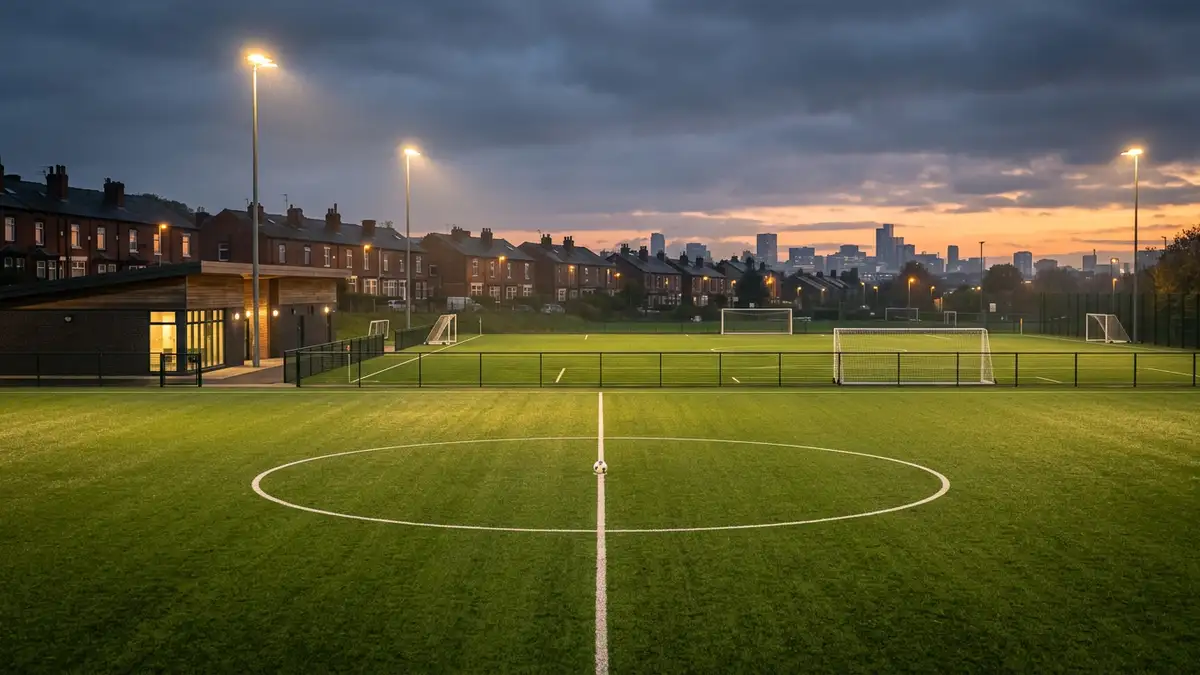
For most people in Greater Manchester, the more immediate news may be what happens on local recreation grounds rather than in the big stadiums. Under the proposed partnership, the GMCA will work with the Football Foundation, the UK’s largest sports charity, which is funded by the Premier League, the Football Association and the government.
The plan is to invest up to an extra £215 million over the next ten years to deliver more than 150 new and improved pitches and changing facilities across the ten boroughs. The combined authority says that, together with projects already under way, total current and proposed spending on grassroots facilities in the city region would pass £250 million. The partners intend to identify priority sites and link new pitches to wider regeneration schemes.
Changing rooms built for women and girls
A central aim is to remove the barriers that put women and girls off playing. Bev Craig said girls and women across the region were too often held back by facilities that “just aren’t good enough”, including a lack of proper changing rooms. Greater Manchester’s Women’s Football Board, which has campaigned for facilities designed with female players in mind, has welcomed the deal.
Work has already begun on two new Football Foundation multisport hubs in Wythenshawe. One of them, Wythenshawe Sports Ground Hub, is planned as a flagship site for women’s and girls’ football and will become the home of the South Manchester Girls’ League once complete.
Football Foundation chief executive Robert Sullivan said the benefits would reach well beyond football, from physical and mental health to bringing communities together, and that partnerships of this kind allowed the charity to deliver facilities faster.
What the Women’s World Cup 2035 could mean for Manchester
Major tournaments bring visitors, hotel bookings and spending in bars, restaurants and shops, and the GMCA expects a significant boost for the local economy if matches are confirmed in the city region. Manchester has a track record of staging big events, from the 2002 Commonwealth Games onwards, and the 2022 Women’s European Championship showed how much appetite there is for women’s football in England.
The longer-term test will be legacy. The four football associations said the years ahead would be spent on facilities, coaching, officiating and the pathways that take a girl from her first game to a professional contract, adding that the players who will light up 2035 are already in parks and playgrounds today. For Greater Manchester, the success of the tournament may ultimately be judged less by which stadium hosts the final than by how many new players are using those 150 pitches by the time it kicks off.
Final venue choices and the match schedule will be decided by FIFA and the organisers closer to the tournament. Elsewhere in Manchester football, City recently won an appeal over a red card from their Chelsea defeat.
Sources: Greater Manchester Combined Authority; FIFA; The FA; BBC Sport; Sky Sports; Manchester Evening News.

