




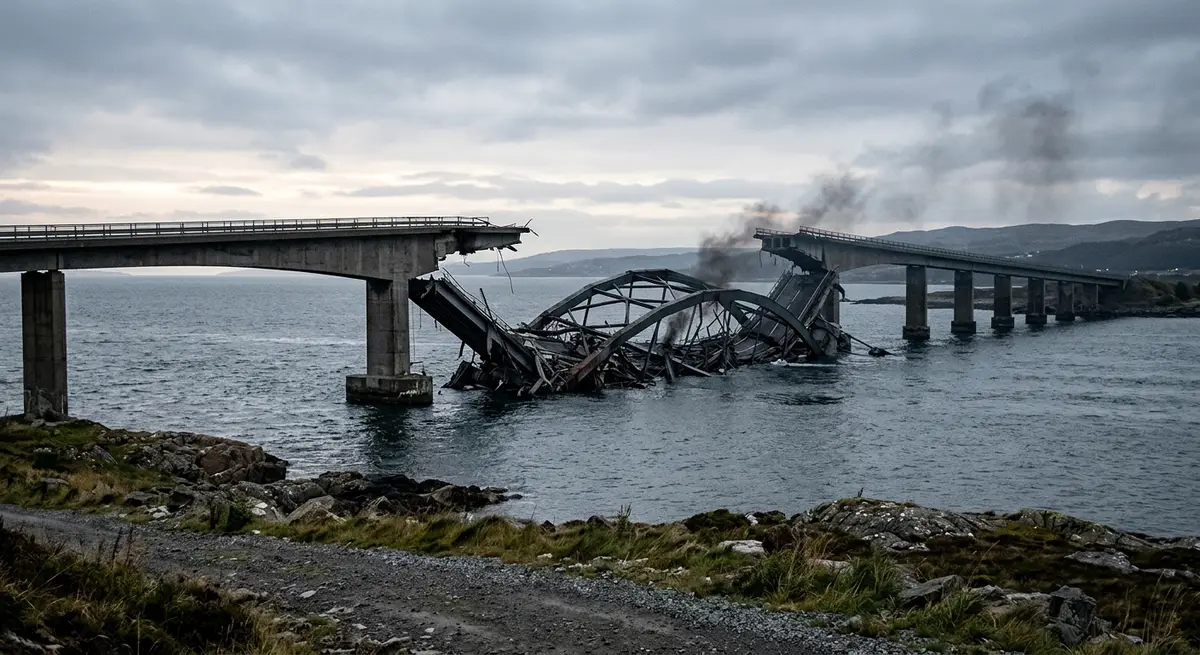
A section of the Crimean Bridge, the road and rail link between Russia and the occupied Crimean peninsula, has collapsed into the Kerch Strait after a Ukrainian missile and drone attack, in one of the most significant strikes of the war.
The attack overnight into Tuesday came hours after Russia hit two of Kyiv’s main bridges across the Dnipro River, closing them to traffic and disrupting water and power in parts of the Ukrainian capital.
A ‘seven-phase’ operation
President Volodymyr Zelensky described the strike as the final stage of a seven-phase operation that had run for several weeks, in which Ukrainian forces gradually took out air defences, radars and electronic warfare systems on the approach to the target. He said Ukraine had used several types of drones alongside its home-made Flamingo and Neptune cruise missiles, the BBC reported.
Ukraine’s Security Service (SBU) said that “one of the metal arches and the automobile span under it were completely destroyed”, according to the Kyiv Independent. Ukraine’s General Staff said the railway section was still standing, though its arch was damaged.
“Russia strikes our infrastructure every day, including bridges,” Zelensky wrote on X, as quoted by Reuters. “We are … reminding Russia that war will always return to where it began.”
The strike followed an earlier hit on the bridge on Monday, which the Kremlin had described as causing only minor damage. Russia’s defence ministry said it shot down 1,441 Ukrainian drones over 22 regions overnight into Tuesday, which Reuters said surpassed the record set the previous night.
Moscow’s response
Kremlin spokesman Dmitry Peskov said President Vladimir Putin had been briefed and that the bridge would be restored “even better than before”. Russian investigators confirmed structural damage and opened a criminal case on terrorism charges.
Accounts of casualties differ. Crimea’s Russian-installed governor, Sergei Aksyonov, said two people were killed, according to Reuters, while Russia’s transport ministry had earlier said that, on preliminary information, there were no casualties. Rail services across the bridge resumed later on Tuesday after a pause, and drivers were advised to use car ferries.
Ukrainian experts expect repairs to take a long time. Military aviation analyst Andrii Kharuk told the Kyiv Independent: “I believe restoring this section will take not just months, but a year or even longer.”
Kyiv’s bridges hit
In Kyiv, Mayor Vitali Klitschko said Russian strikes late on Monday hit the Northern and Southern bridges, two of the key crossings over the Dnipro. The attack partly damaged the metro and caused some power and water outages. The Southern bridge partially reopened on Tuesday.
Zelensky said four ballistic missiles had been aimed at the Southern bridge and three at the Northern bridge. Russian strikes on energy facilities also cut power to consumers in eight Ukrainian regions, Ukraine’s deputy energy minister said.
Why the bridge matters
The 19km bridge was built after Russia annexed Crimea in 2014 and opened to road traffic in 2018, when Putin drove a lorry across it. It is seen as a personal symbol of his rule and has been attacked several times since the full-scale invasion in February 2022, including a truck bomb in October 2022.
Russia now relies more on a land corridor through occupied southern Ukraine to supply its forces, but the bridge still carries military and civilian traffic. It also spans the shipping channel into the Sea of Azov. Andrey Sizov of the consultancy Sovecon told Reuters the collapse could “substantially delay any eventual resumption of shipping from the Sea of Azov” because debris must be cleared.
What it means for UK readers
The strikes come at a sensitive moment for diplomacy. US-brokered talks in Abu Dhabi last week produced a prisoner exchange but no breakthrough on territory, and Putin is due in China this week for meetings culminating in a summit with US President Donald Trump and Chinese President Xi Jinping. The UK, a leading backer of Kyiv, has been focused on strengthening Ukraine’s air defences ahead of winter, when Russian attacks on power and heating typically intensify.
What happens next
Russia has set up a government commission to deal with the consequences of the attack, and the scale of repairs should become clearer once engineers assess the fallen span. Many Ukrainians expect Moscow to answer with further strikes on energy and transport, while attention turns to whether the summit in China changes the course of the talks.

