




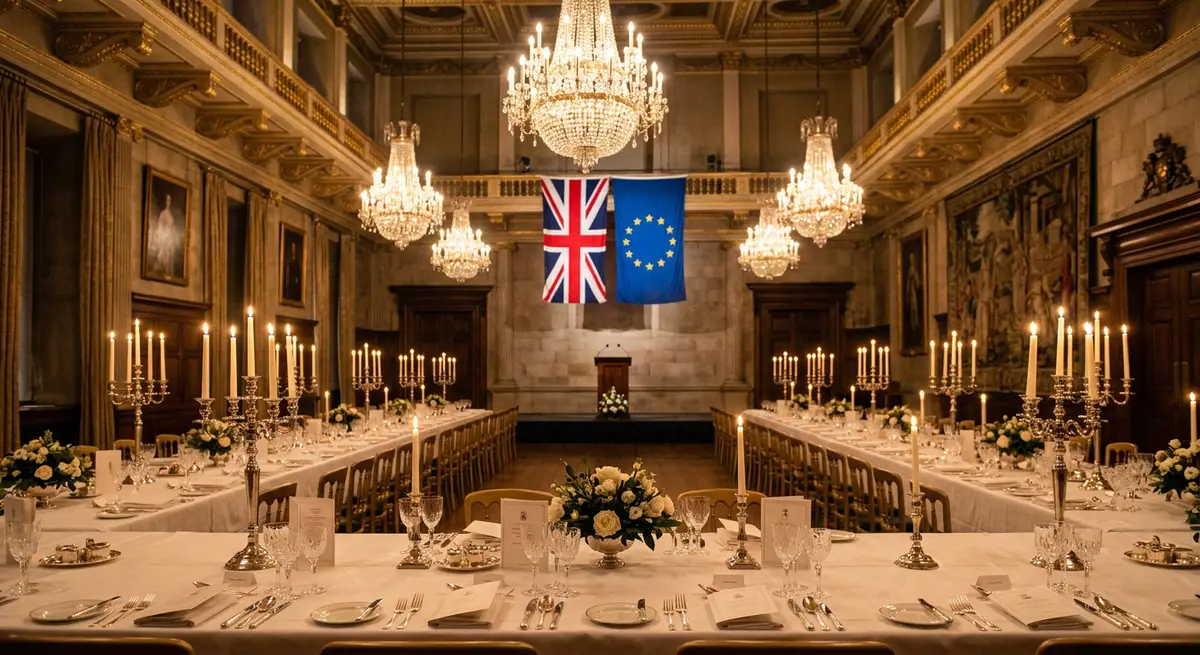
Andy Burnham will travel to Brussels on Friday for a UK-EU summit after telling an audience in the City of London that the Brexit deal Britain ended up with has failed to deliver what was promised.
Speaking at the Lord Mayor’s Banquet on Monday 16 November, the Prime Minister compared the current arrangement to the emperor’s new clothes. “Well, I say it as I see it. And to be frank, the emperor has nothing on,” he said, according to BBC News. “The Brexit we were given has not worked. We have lost more than we have gained.”
He argued that “a needlessly hard Brexit” had put barriers in front of businesses and that the promise to “take back control” had not been met. It was the first major foreign policy speech of his premiership, and the full transcript has been published by Downing Street.
What Friday’s summit is expected to deliver
Friday’s meeting is expected to seal three agreements whose substance was largely settled under Sir Keir Starmer: a deal removing post-Brexit checks on food and agricultural goods, a link between British industry and the EU’s emissions trading system, and a youth scheme allowing young people to work, travel or study for limited periods on either side of the Channel.
The government says the food deal will cut costs for businesses and could bring down prices in the shops. Critics say it makes the UK a “rule taker”, following EU regulations it has no vote on.
Negotiators were still working on the final text this week. According to the Guardian, a leaked draft showed continued disagreement over EU demands that the UK align with the bloc’s trade defence measures in return for being included in its Made in Europe legislation. EU diplomats told the paper the two sides were expected to settle on a youth mobility quota of about 100,000 people a year. The deals would then be put into law through a European partnership bill, which is expected before Christmas.
Burnham set out three tests for any agreement. It must respect Labour’s 2024 manifesto pledge of “no return to the single market, the customs union, or freedom of movement”. It must improve on the original deal and bring it closer to what people thought they were voting for in 2016. And it must pass what he calls the “Makerfield test”, named after his Wigan constituency, by making a visible difference to people’s everyday lives.
A longer debate, and a cautious Brussels
The bigger question is what follows. Burnham has said that after the summit he will begin discussions about options for the UK’s long-term relationship with the EU, ranging from no change, through a customs union or single market membership, to rejoining. He has ruled out any major change before the next general election and said “the British people will be the boss” at every stage.
Those options are now expected to be set out alongside his 10-year plan in December. Sources quoted by the Guardian said ministers were considering a year-long “national conversation” in 2027, including town halls and citizens’ assemblies.
Brussels does not appear keen on more incremental deals in the meantime. “Clarity is what we need more than anything from the UK. Don’t come back until you know what you want,” one EU diplomat told the Guardian. Another said there would be a “pause for reflection” after Friday.
Opposition parties have attacked the plan from both directions. The Conservatives accuse Labour of “dragging us into the European Union via the back door”, and Boris Johnson told the Daily Telegraph: “It is madness to escalate the Brexit issue as your political priority.” The Liberal Democrats call the food deal “a patch, not a fix” and want to rejoin the single market, while the Greens back a return to the customs union.
What it means for Manchester readers
The Makerfield test puts Greater Manchester at the centre of the argument. Burnham is promising that whatever is agreed will be judged by what it does for the least well-off communities, including the towns around Wigan that elected him in June.
For the region’s manufacturers, food producers and hauliers, the most immediate change would be fewer checks and less paperwork on goods sent to the EU. For shoppers, the government’s claim that the food deal could ease prices will be tested over the coming months. The youth scheme, if agreed, would give young people from Greater Manchester a route to work or study in Europe for a limited period, and bring young Europeans the other way.
What happens next
The summit takes place in Brussels on Friday 20 November. If the three agreements are signed, legislation is expected before Christmas, followed by Burnham’s long-term options in December. Any move towards rejoining the customs union, the single market or the EU itself would, on his own timetable, need a mandate at the next general election.

